

Admittedly, this is not going to be an article for everyone. If anyone ever asks for proof that I don’t write for clicks, this is it.
I built a Faraday cage. It took forever. It’s not my finest work, but I got through it.
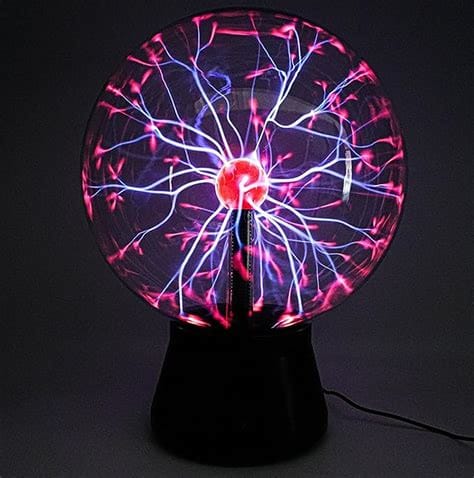
I built it because I wanted to replicate an awesome intention (mind over matter) experiment that involves a plasma globe. Yes, the same globe you could find at Spencer’s or a toy store. You can read about the genesis of the experiment here, but this article isn’t about that. It’s about my journey building a Faraday cage and exactly what not to do.
Let’s start with the “why.” Plasma globes are apparently extremely sensitive to RF interference. For the experiment to succeed, I needed to measure tiny fluctuations in the behavior of the plasma tendrils, and I needed to control for outside influences like the electronics scattered around my lab, including the Raspberry Pi recording the globe.
This turned out to be quite difficult. Who knew my workspace was filled with a dense fog of RF interference? I went through several painful iterations of my original design, and I’m sharing where I landed in the hope of saving time for anyone else foolish enough to try this.
Let's start with the premise.
A Faraday cage is an enclosure made of conductive material, such as solid metal or metal mesh, that blocks electromagnetic fields. It works because the electrons in a conductor are free to move. When an outside electric field or radio wave hits the cage, those electrons shift in response, creating an opposing field that cancels the original one inside the enclosure. The outer metal reflects or absorbs the energy before it reaches the interior.
The cage doesn’t have to be solid. A conductive mesh works as long as its holes are much smaller than the wavelength of the signal you’re trying to block, which is why you can see through your microwave door but the microwaves can’t get out.
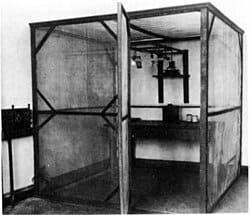

The catch is that a shield is only as good as its weakest point. Any gap, unsealed seam, or wire passing through the wall gives outside signals a path in, which makes building one that works much harder than it looks.
Choosing the mesh
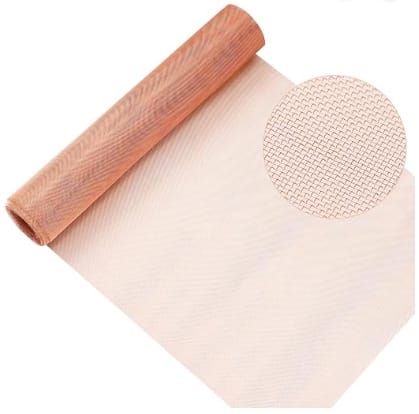
The first design decision was the conductive material for the outside of the cage. I chose 99.9% copper 40 mesh and bought a 36" x 20' roll from Amazon, since I needed enough for a big enclosure. The listing specifically said it was good for shielding applications.
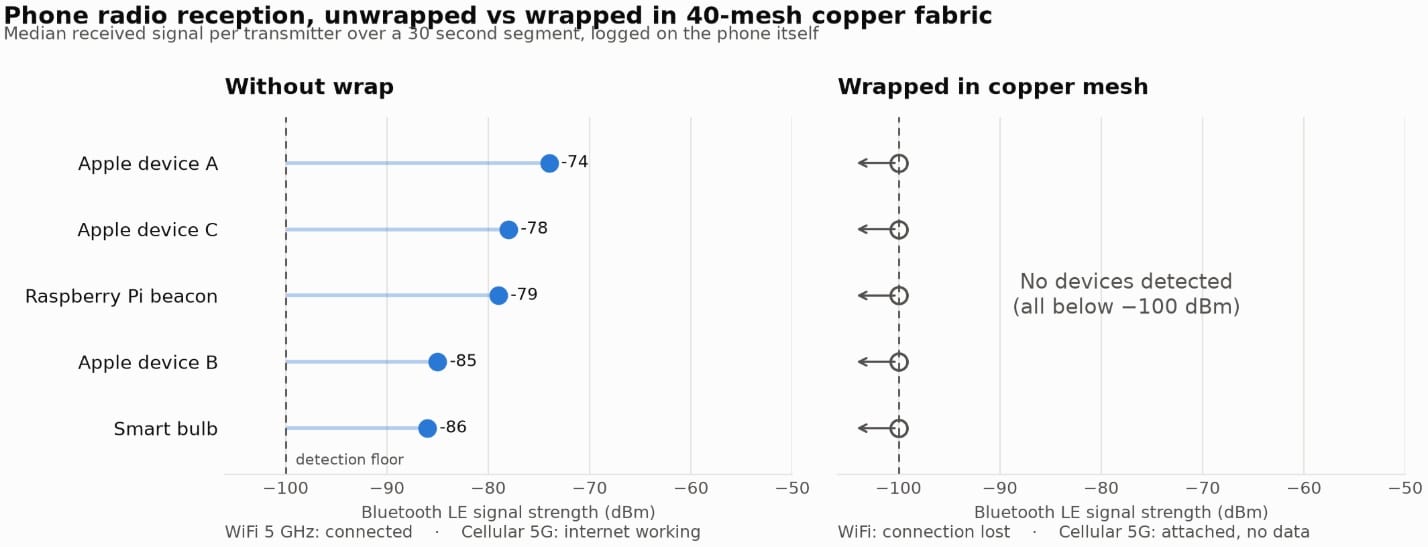
I wanted a baseline, so I ran the easiest useful test I could think of. I wrapped my phone loosely in a few feet of the mesh, folded the edges over tight, and had a sensor logging app record every radio the phone could hear (Bluetooth, Wi-Fi, and cellular). I logged thirty seconds bare and thirty seconds wrapped, with the phone in the same spot.
Side note: My phone is an Android, and I use the excellent “Sensor Logger” app. It can log and export essentially any sensor or radio active on the phone. I’ve used it on several projects.
The test worked as I’d hoped. Bare, the phone heard half a dozen Bluetooth devices around the house at signal strengths between -65 and -90 dBm, kept a 5 GHz Wi-Fi connection, and had working 5G service. Wrapped, the Bluetooth log went completely silent. Not one device appeared in over thirty seconds, which means everything fell below the phone’s detection floor of roughly -100 dBm. That’s at least 30 dB of attenuation, though mesh that close to a phone can also detune its antennas, so some of the drop may have come from the phone itself.
The cellular reading was the most interesting of the three. The phone stayed registered to the Verizon tower, but it couldn’t send or receive any data. The housekeeping traffic that keeps a phone registered runs on the slowest, most heavily error-protected signaling the standard allows. It’s designed to survive basement-grade reception, while actual data needs a much stronger signal. A shield that blocks the link hard, but not completely, leaves exactly this kind of fingerprint.
From my perspective all of this suggested that the mesh would be adequate for the cage.
The bigger test
I wrapped a plywood shell in the mesh, taped every corner and seam with copper tape, and set it on an aluminum sheet base. The globe runs on a battery and sits on a wood platform inside the cage along with a camera that connects by USB to the Raspberry Pi sitting six inches outside the box.
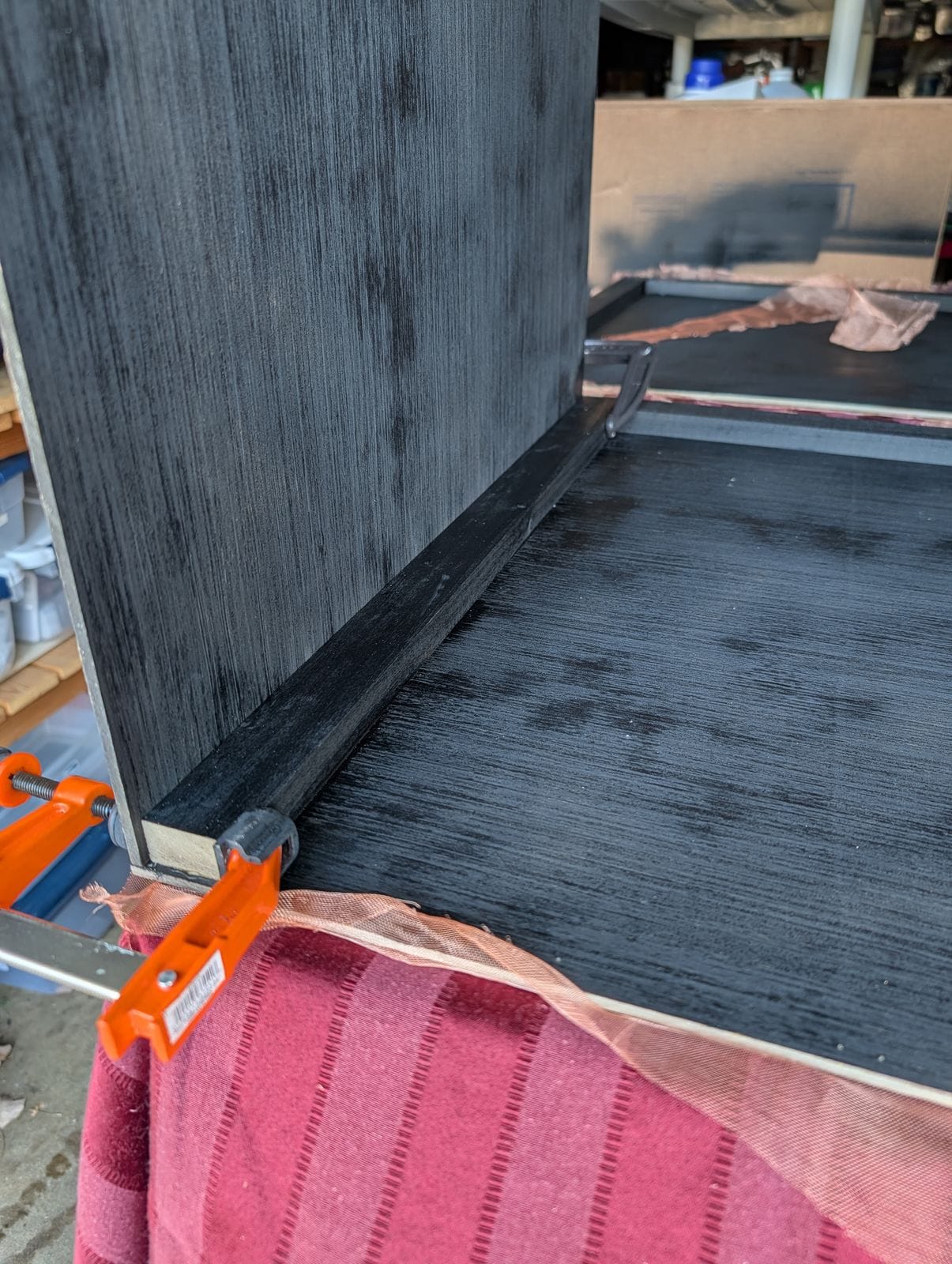
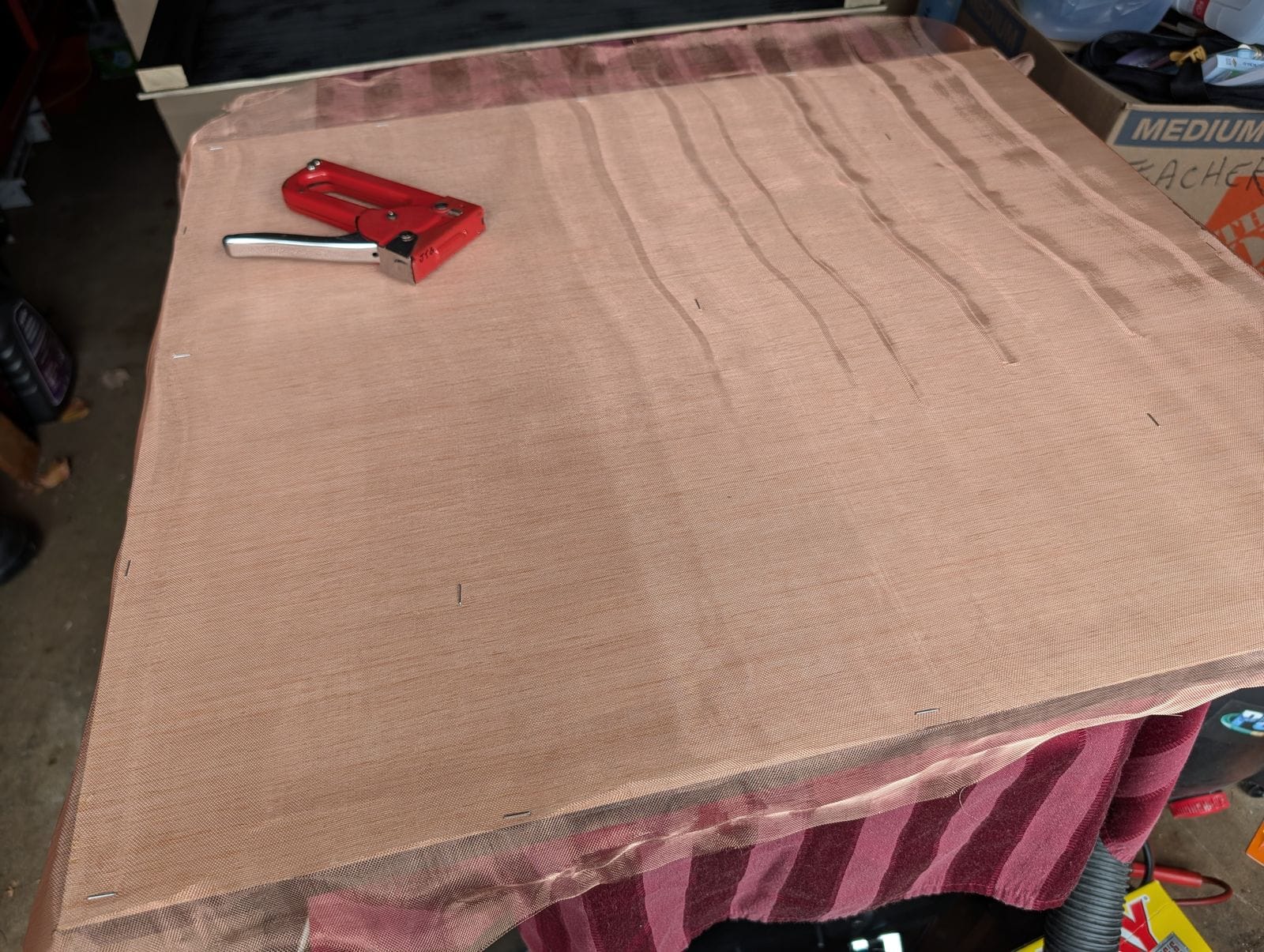
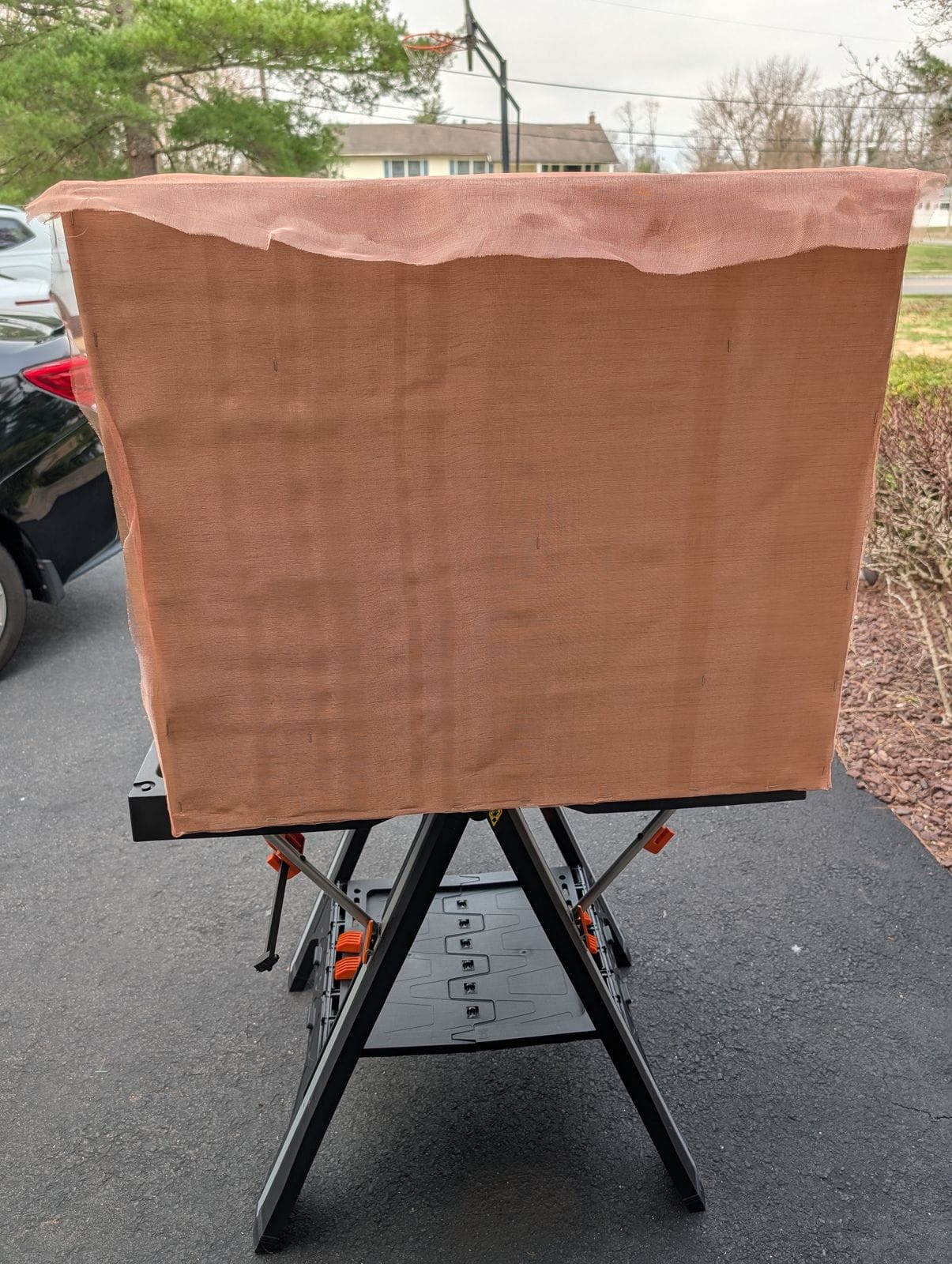
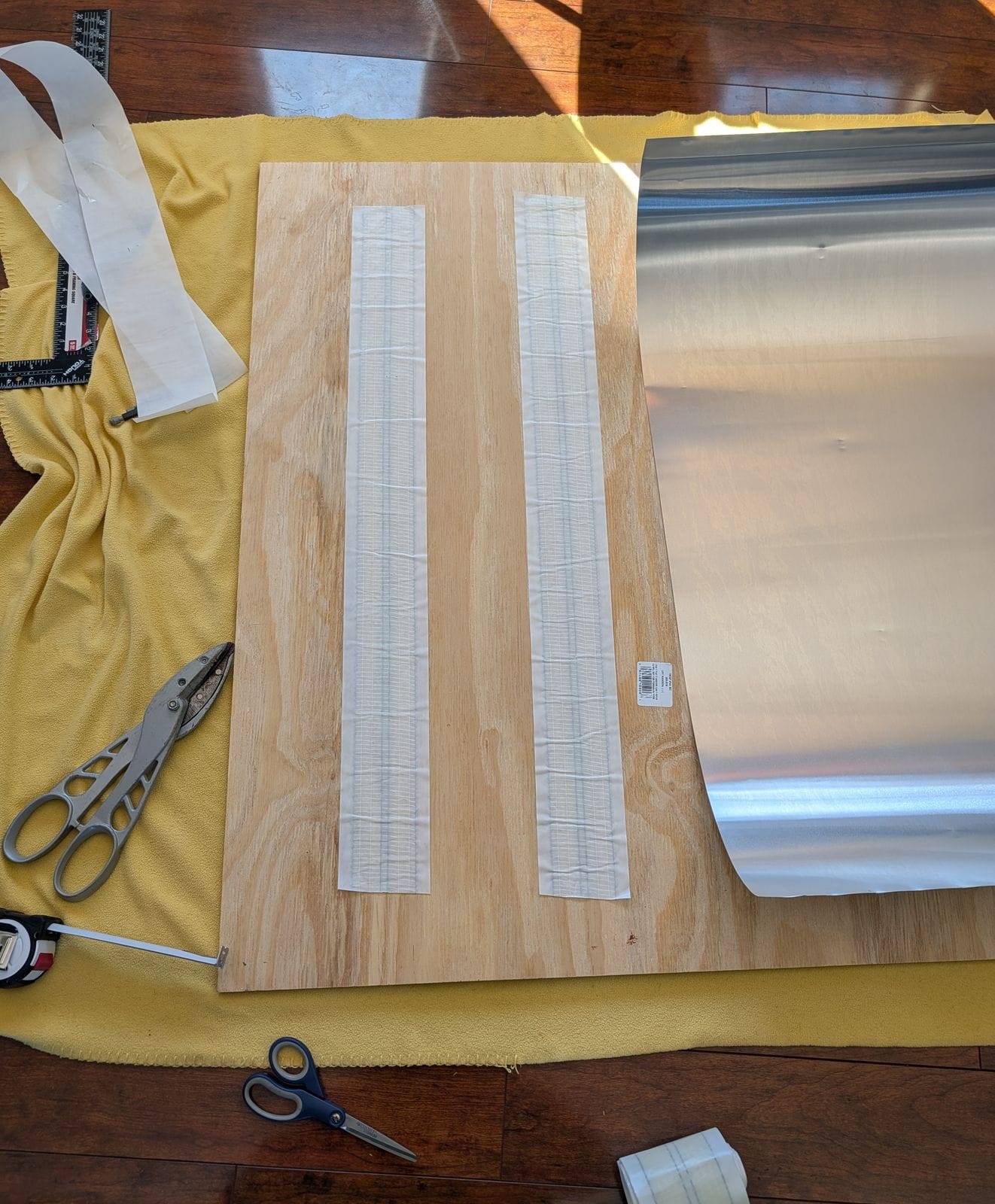
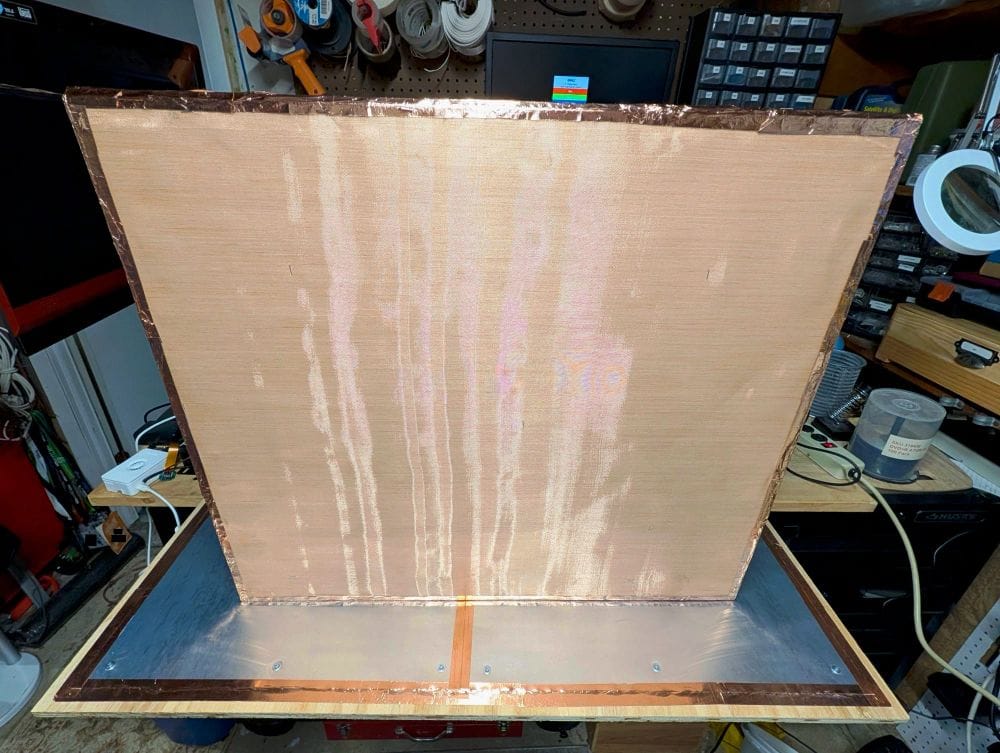
Oddly, when trying out the cage, my first measurement showed only about 10 dB of shielding, so I made a decision to build a second, foil-lined cardboard box around the first.
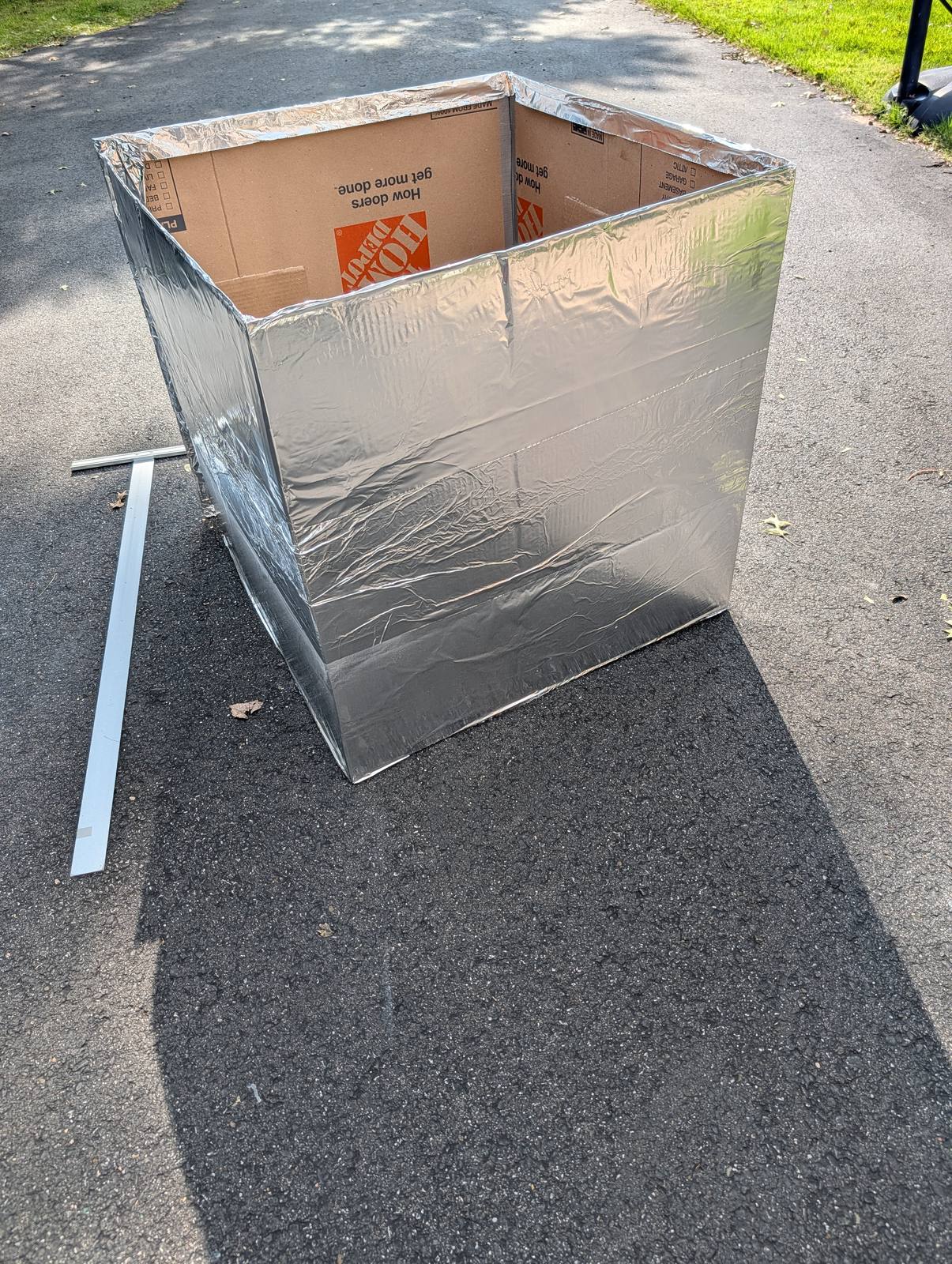
With the box-within-a-box finished, it was time for the big test. Would I get anywhere near my baseline?
Sadly, no. Remind me again why I decided to build this?
The timechart below (thank you, Claude) tells the sad story. The shaded region shows when my phone was in the box. I’m tracking Bluetooth here, with my nearby Raspberry Pi configured as a beacon. The signals from more distant Bluetooth devices decreased, but the Pi’s signal (in blue) stayed fairly strong.
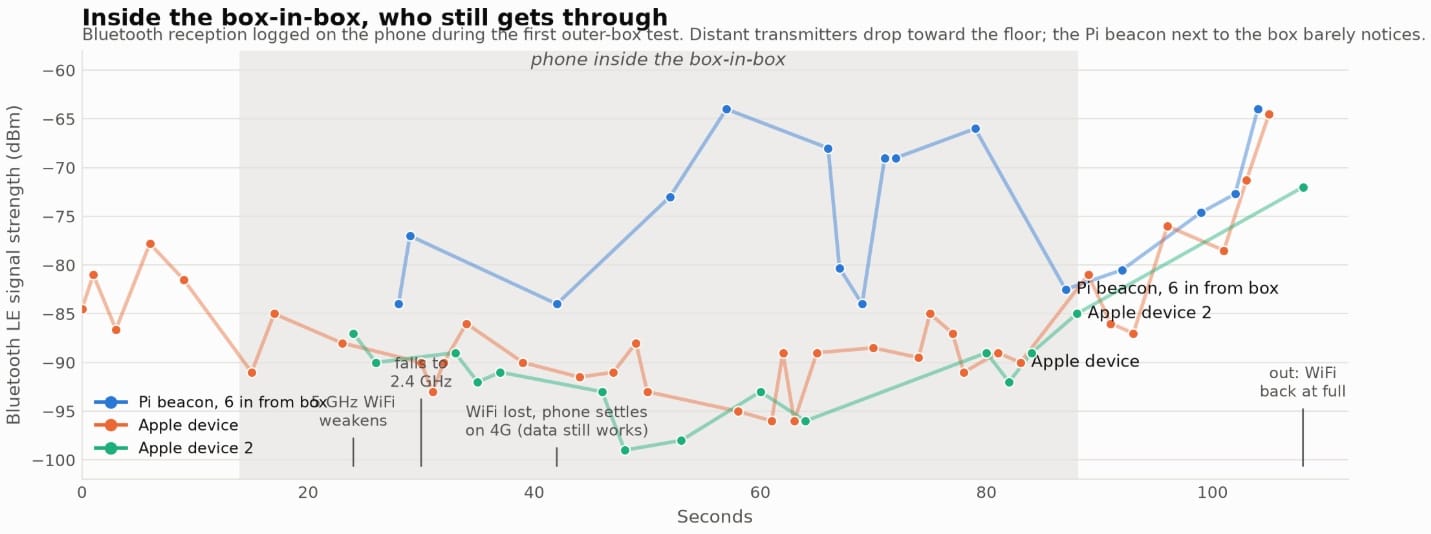
That left two likely explanations:
- The seam between the bottom of the cage and the aluminum platform was letting a signal through.
- The USB cable leaving the inner box was acting as an antenna.
Back to the drawing board...
Giving up on the box-within-a-box idea
After giving the two suspects a lot of thought, I decided I had a more fundamental problem: I hated the outer box...
My experiment sits in a cramped corner of my garage with rafters directly overhead, so I couldn’t simply lift a big box up and over the inner one. I had to assemble it in place, fitting foil-covered panels around the cage and adding a separate, free-floating cardboard top. Every adjustment inside the cage meant reassembling the foil box and risked tearing the copper mesh.
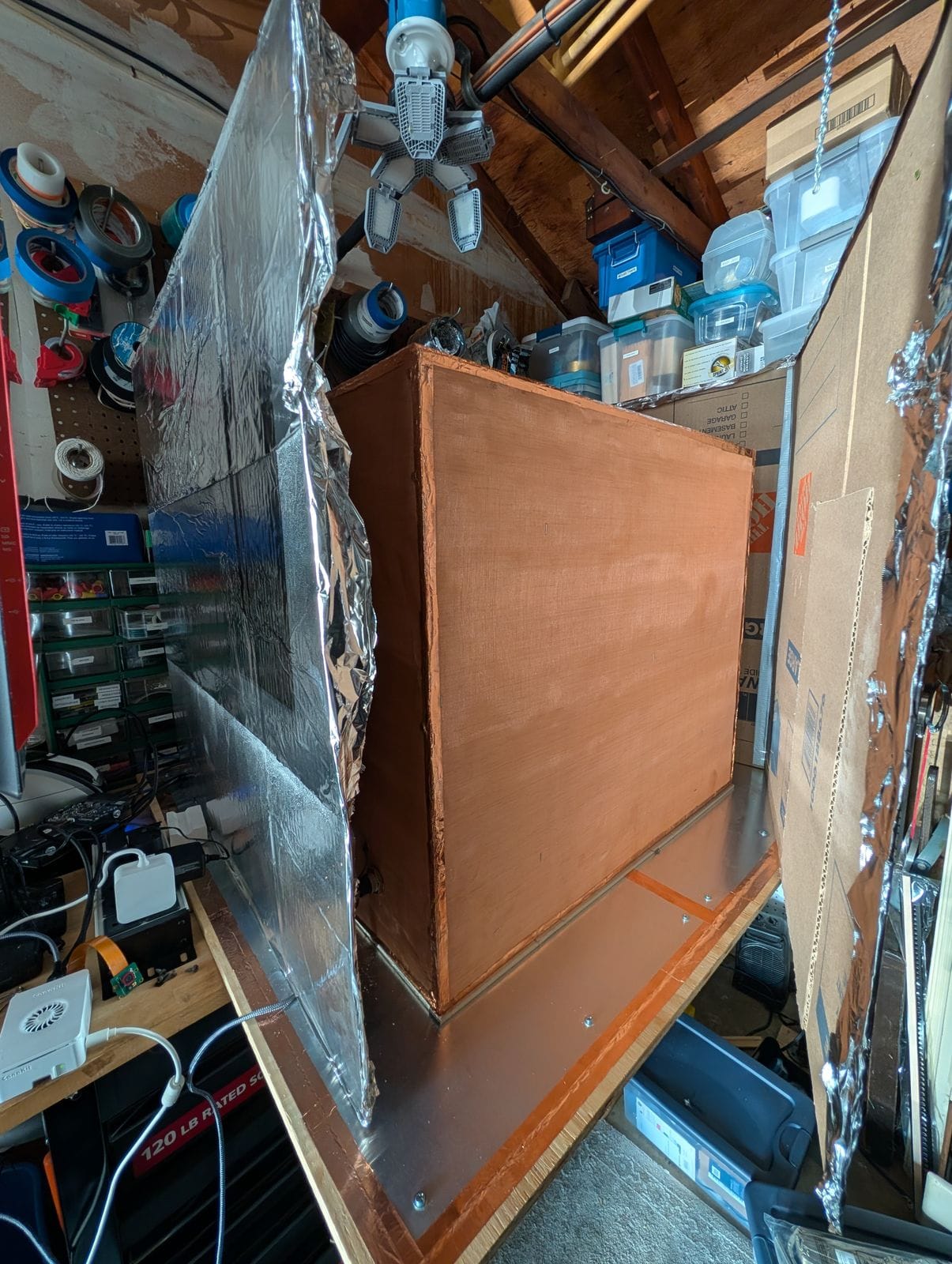
That might have been workable if the foil had made an appreciable difference, but it didn’t. The signals from distant Bluetooth devices dropped by only about 2 dB compared with the copper box alone, and the Pi’s beacon was essentially unchanged.
So I gave up on the foil enclosure. The juice wasn’t worth the squeeze. I briefly considered an oversized top with a mesh curtain hanging down to the cage floor, but then I remembered that the Faraday cage was supposed to be the EASY part of the overall project.
I went back to the copper box alone and decided to test my two suspects one at a time.
The segment tests
The plan was simple: leave the phone logging inside the box, change one thing, and record for 60 seconds. I knocked on the table to mark the start and end of each segment, because the phone’s accelerometer picks up the knocks. Since the phone never moved, any big change in signal should have come from what I’d just changed.
The first suspect was the USB cable. I logged the box as it was, then unplugged the outside cable, then covered the USB coupler with foil.
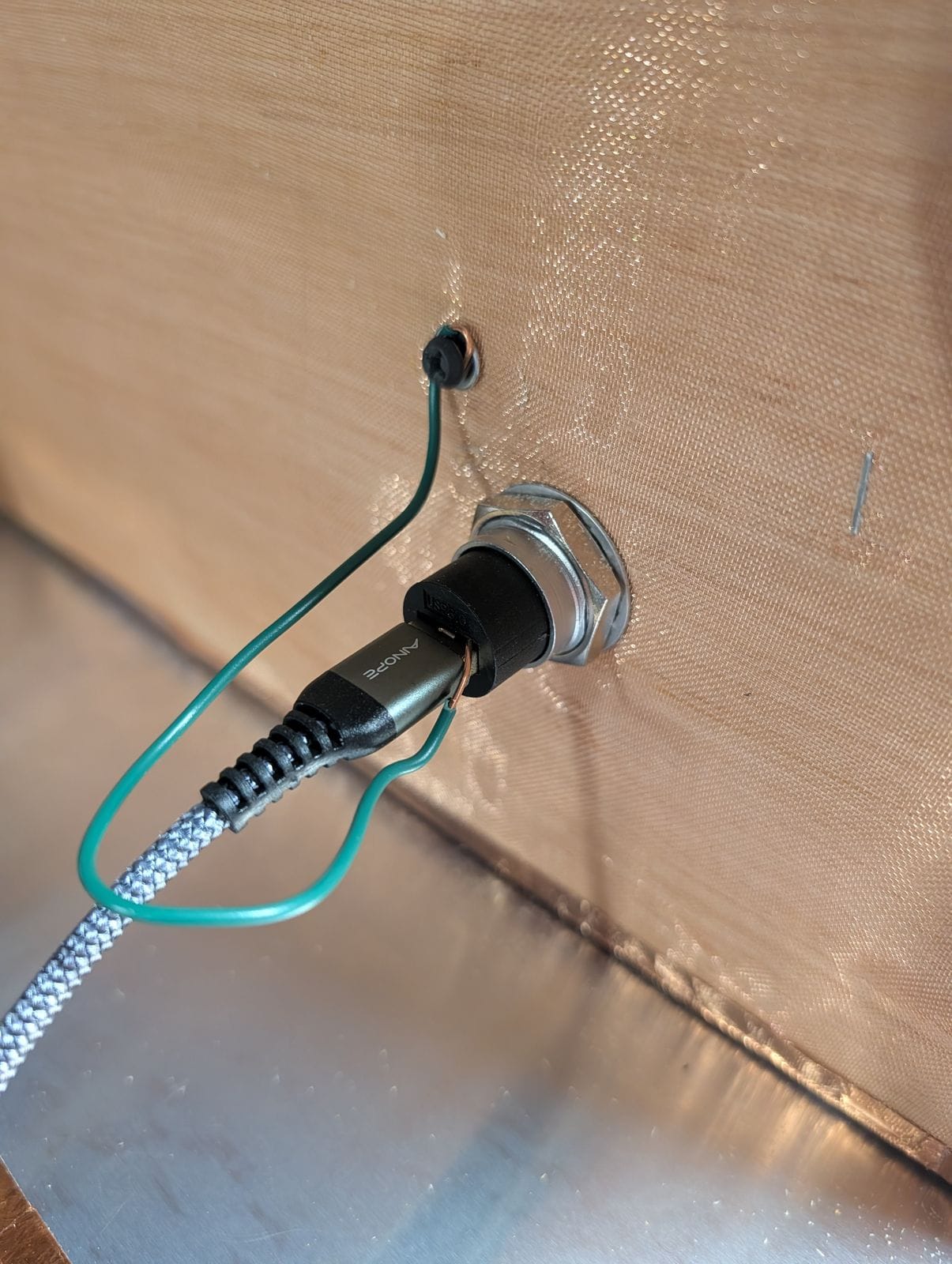
| Setup | Pi beacon (median) |
|---|---|
| Cable connected | -84.5 dBm |
| Cable unplugged | -84 dBm |
| Foil over the coupler | -83 dBm |
Nothing happened.
Bluetooth readings are noisy enough to hide a swing of about 10 dB, but I didn’t see the big change I was expecting. The cable wasn’t the main culprit.
The second suspect was the cage seam closest to the Pi. I laid extra copper mesh over it, removed it, and repeated.
| Setup | Pi beacon (median) |
|---|---|
| No mesh on the seam | -81 dBm |
| Mesh on the seam | -81.5 dBm |
| Mesh removed | -79.5 dBm |
Again, nothing. In both tests my phone dropped off Wi-Fi around the time I first handled the mesh, but it never reconnected when the mesh came off, so I can’t give the mesh credit for that.
Oddly, Bluetooth logging stopped at the 298-second mark in both recordings, even after I set the app’s battery use to unrestricted. Something in the app or the phone appears to stop it at about five minutes. That left me with only one clean on/off cycle with the mesh, so this test can’t rule out a small effect. It does rule out the big, easy fix I was hoping for.
At this point, I gave up.
I couldn’t find a straightforward reason why the cage wasn’t more effective. That’s the honest truth, and I wasn't going to devote any more time to this particular hunt.
So what did I actually achieve?
Here's the bottom line: Across the two test recordings, the Bluetooth devices I could hear both outside and inside the cage dropped by about 10 to 18 dB, with a median of about 14 dB.
If decibels aren’t part of your daily existence, here’s what that means:
| Drop | Signal power blocked | Signal strength reduced by |
|---|---|---|
| 10 dB | 90% | about 3x |
| 14 dB | 96% | about 5x |
| 18 dB | 98.4% | about 8x |
| 30 dB | 99.9% | about 32x |
| 60 dB | 99.9999% | 1,000x |
So my cage blocks about 96% of the signal power from distant Bluetooth devices at 2.4 GHz.
That sounds impressive until you look further down the table. As a rough guide, a well-built DIY enclosure might reach 30 to 50 dB, while a professional shielded room can go far beyond that.
Some caveats: I measured with a phone, not calibrated test equipment, and used only a handful of devices as a reference. Some fell close to the point where the phone couldn’t hear them at all, so their true drop could be larger. And Bluetooth is only one frequency band, so this number says nothing about the others.
The cage also looked much less effective against a transmitter right next to the wall. My Pi’s beacon lost only about 1 to 8 dB. Treat this as a rough number, though: moving the phone into the box also changed its distance from the Pi, and distance affects signal strength too.
All this brings me to the thing I should have worried about first...
Dealing with the Pi
Admittedly, This took me WAY too long to realize: I was trying to shield the experiment from a computer I had placed six inches away from it.
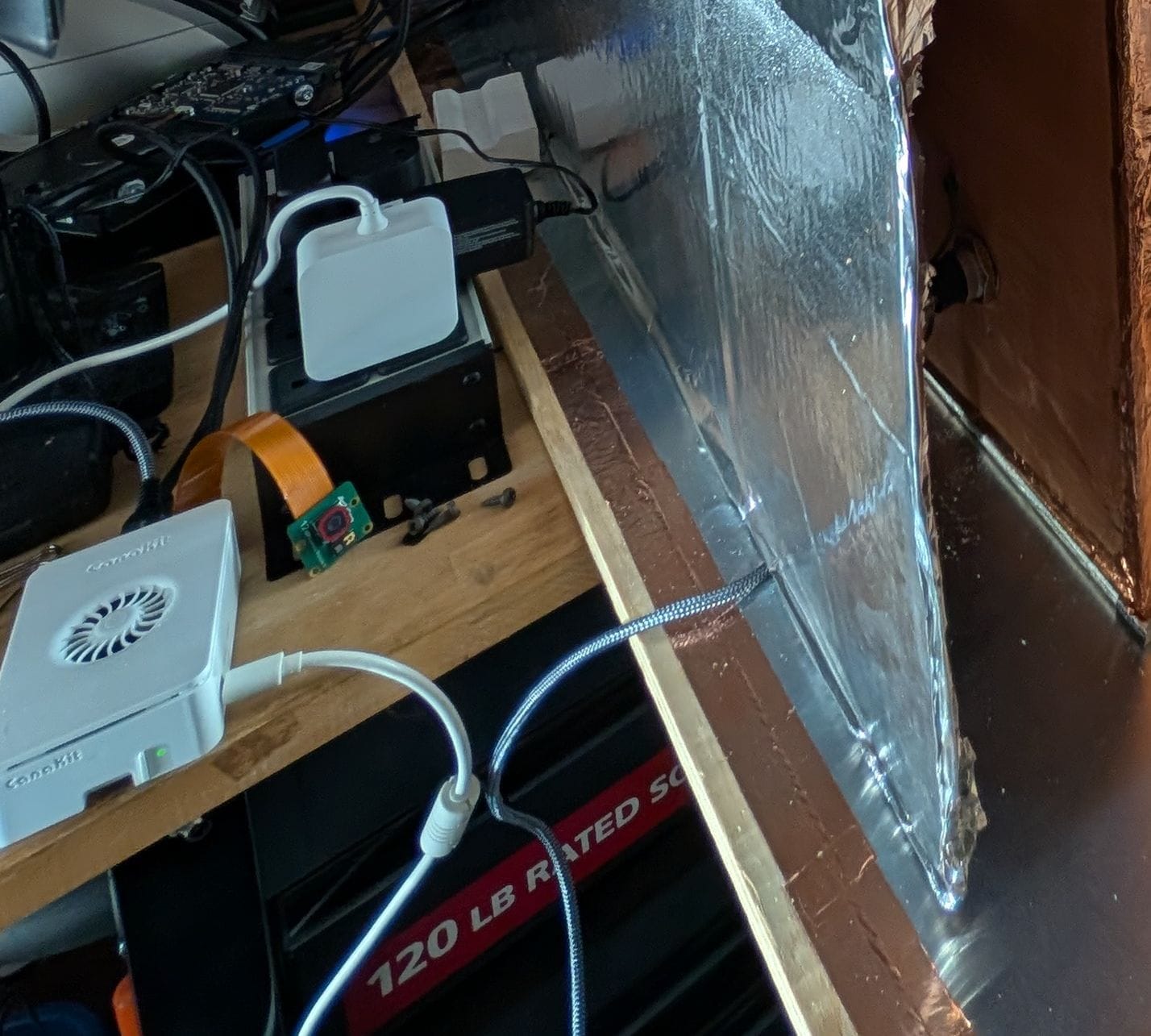
The globe experiment will run in an empty garage, so I don’t have to worry about people nearby. The Pi is the main thing I need to control for. Rather than building any more shielding, I’m going to do three things:
- Turn off its radios. The Pi connects over Ethernet, so it doesn’t need WiFi or Bluetooth during a session. A radio that’s off doesn’t need to be blocked.
- Move it away from the cage. A longer shielded USB cable will let me put a few feet between the Pi and the globe instead of six inches.
- Measure whether it even matters. With the garage empty, I’ll have the Pi switch between randomized trials: radios on versus off, and heavy CPU load versus idle. If the tendrils respond to any of that, I should see it in the data.
The experiment’s design also helps. Steady background noise from the Pi can’t produce a false result by itself, because it would have to change along with the direction a participant is aiming at. And the matched control sessions run the same software with nobody participating, so any effect tied to the conditions should show up there as well.
None of this will definitively prove whether the Pi affects the experiment. I can’t test with the Pi completely off, since it’s recording the footage, and the testing doesn’t cover the camera, which sits inside the cage with the globe.
So that’s where the cage stands: about 14 dB, well short of what I set out to build, for reasons I never figured out. ( I’m stopping anyway.) The cage was supposed to support the experiment, and it was starting to take more time than the experiment itself. Even a better cage would leave a computer, a camera, and a cable close to the globe, so the more useful question now is whether any of them actually moves the tendrils, and that’s something I can test regardless.
My closing advice: If you’re ever thinking of building one of these, measure early, change just one thing at a time, and decide up front how much shielding you need and how long you’re willing to spend getting it in place.
Lessons learned.
Dear reader, as you can tell from what we cover, we don’t write for a search algorithm, and we don’t run ads of any kind. That’s because, with AI, the web business model we’ve all known and loved is broken. We think a subscription is the fairer deal, so if you get something (anything) out of these articles, consider becoming an Insider. A tip or a share helps too.
If headlines are more your vibe, our sister site enigmaticnews.com collects the day’s paranormal, UFO/UAP and high-strangeness stories from vetted sources, curated by a person and updated daily.
Thanks for reading, and for keeping this site going!
Read next

Reimagining the Spirit Box: Part III
The complete plans for the Decker Device: parts, wiring, every command and the lab notes, for under $300 and a weekend. Insiders only.

Lessons Learned Building a UFO Classifier
My first approach to analyzing 152,000 UFO sightings had a 34% accuracy rate. I almost published it anyway. Here's what went wrong with semantic embeddings, why I pivoted to LLM extraction, and the methodology that actually worked.

Building a UAP "Dog Whistle": Exploring the Skywatcher Phenomenon
Building our own UAP 'dog whistle' device using a Raspberry Pi Zero, battery, and custom Python code. Inspired by Skywatcher's tech, we're sharing the complete DIY guide.

On Controlling Devices with Your Mind - Part II
Is it possible to control a device with your mind alone? Check out my journey exploring the science behind mind-matter interaction in this two-part series.