
The Skinwalker was a Dog
The surprisingly clear-eyed science in the Pentagon's Utah Ranch File

On October 23, 2026 the Pentagon released its latest batch of UAP records under the PURSUE program. It's the seventh release, and it contains only 28 files. It's an odd grouping: almost half of the files are dated before 1965, there's a gap for the '70s through the '90s, and the remaining 11 are recent, covering the last two decades.
Just figuring that out was a chore. It shouldn't have been, but the Department of "War" website is SO bad. The selector to sort by "Incident Date" doesn't work correctly, and honestly the whole layout looks like a set backdrop from The X-Files in 1993.

As bad as the site is, some of the reporting is actually quite good. In particular, I thought the 60-page "Utah Ranch Investigation" document (DOW-UAP-D174) contains some real science and is the most interesting in the batch. I shouldn't be surprised that it's good, since it's a field report that wasn't even produced by the military. It was created by BAASS.
So, who is BAASS and why is this document even in the pentagon release?
The report's author is Bigelow Aerospace Advanced Space Studies, or BAASS. BAASS was a company Robert Bigelow set up in 2008 specifically to win a Defense Intelligence Agency contract under a program called AAWSAP, the Advanced Aerospace Weapon System Applications Program. AAWSAP is the $22 million effort that later got labeled in the press as "the Pentagon's secret UFO program" after the 2017 New York Times story, and it's the ancestor of everything that followed: AATIP, the UAP Task Force, AARO, and the disclosure fight that ultimately led to this document dump.
What's typically overlooked is that the DIA only funded the program. Bigelow's BAASS team did the real work. "The Pentagon investigated Skinwalker Ranch" is accurate only in the sense that the Pentagon signed the checks. The boots on the ground were Bigelow's. Keep that in mind when you see a government seal on the cover: it tells you who paid, not who did the work.
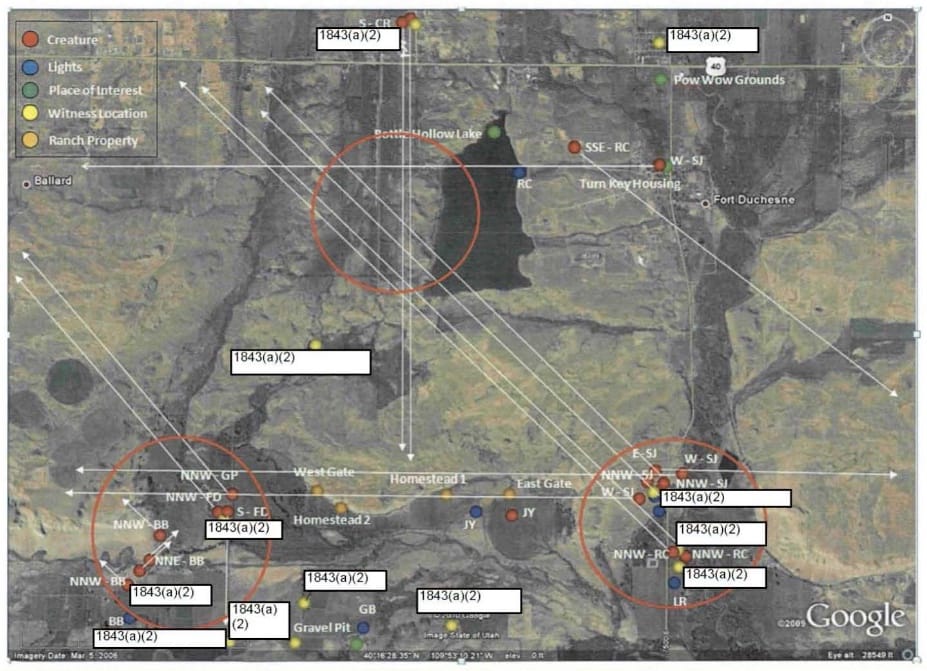
This of course leads to the question of how we know the subject of this report is the Skinwalker Ranch we all know and love, given that the location was redacted. Well, a ton of clues were left in the clear: geographical references such as Ballard, Bottle Hollow Reservoir, and "Skinwalker Ridge." The map on page 6 also labels Homestead 1, Homestead 2, the East Gate, and the West Gate, which are the landmarks from Hunt for the Skinwalker. The report refers to BAASS security personnel stationed on the ranch property, and in 2010 the only ranch in the Uinta Basin with Bigelow's security on it was Bigelow's ranch. Case closed.
25 Witnesses in the middle of nowhere
What grabbed me immediately about this report was the number of witnesses interviewed by 2010 who had seen something truly weird in the vicinity of the ranch. These were all lifelong residents living within a one-to-two-mile radius. The witnesses ranged in age from 15 to 77, and every one of them had a first-hand account. We're not talking about a cherry-picked sample from a major city. This is a thinly populated stretch of the Uinta Basin: a genuinely small radius with a high percentage of local residents willing to go on the record and say they saw "something." Whatever you make of the stories individually, the density of the sightings alone is an eyebrow-raiser.
So, what did they see?
The catalog is crazy. I kept a running list as I read through the report. Here's what the witnesses said they experienced:
- A six-to-seven-foot "dog-like" creature that walks and runs on two legs, seen by eleven separate witnesses. Descriptions vary: black fur, red fur, pure white fur, no fur at all.
- An eight-foot hairless creature with dark gray skin, crouched on top of a shed, that leapt away "like a kangaroo" according to a four-year-old who saw it.
- A hairy arm, three feet long, reaching through a bedroom window at 3 AM: four ten-inch monkey-like fingers, no thumb, dirt-colored nails.
- Small, hairy, three-foot "troll-like" creatures with long arms that run like chimpanzees. Four witnesses.
- A bird the size of an SUV with a 12-foot wingspan, described as a pterodactyl, that two kids watched land in a tree across the street.
- A worm roughly eight feet long and two to three feet in diameter.
- The "Basket Lady": an old woman in rags with black shoulder-length hair, hunched over, jumping from rooftop to rooftop through a housing development. The witness said she's known in Ute culture under that name.
- A red ball of light that hovered four inches from a man's face, smelled of rotten mud, caused a high-pitched ringing in his ears and numbness from his nose to his chin.
- A blue orb that rose from Bottle Hollow Lake, hovered, then shot off toward Skinwalker Ridge, chased by three helicopters.
- Floating white lights that move "behind something as if they were trying to hide," compared by the witness to Glinda the Good Witch arriving in The Wizard of Oz.
- A "ghost car" whose headlights appear in your rear-view mirror on summer evenings with no car behind you.
- A stationary, transparent "portal" 30 to 40 feet tall, rippling like water, seen in mid-afternoon twenty years earlier. The witness said it only caused feelings of peace.
- A humming sound that hovers around a house and shakes the windows.
- Two shadows, nine feet and eight feet tall, outside a bedroom window after a "growling roar" from a stationary animal.
- The sound of children playing and giggling from the ceiling of a house when no children are home.
- Footsteps crossing a kitchen floor, a refrigerator opening and closing, nobody there.
- Tracks in the snow that merge from two sets into one, and tracks that walk straight through a barbed-wire fence.
- Recurring dreams of a black wolf, followed a few days later by a black wolf-headed dog standing at the fence.
There is honestly nothing like Skinwalker Ranch when it comes to the frequency and variety of the oddities witnesses report. The "Basket Lady" and the eight-foot Dune-style worm were both new ones for me.
Imagine being an investigator tasked with unraveling what's actually going on. You'd have your hands full. That's why real science makes a difference.
What separates this document from a ghost-hunting show is the methodology that was followed and the resulting diligence. The abstract lists four objectives, and three of them are objective and measurable: interview everyone, baseline the EM and radiation environment with portable sensors, and use plants as biosensors. (The fourth is a bit more loosey-goosey: "initiate a variety of games, puzzles, and other strategies" to communicate with whatever's there. That makes some specific assumptions about the phenomena, so I'm going to stick with the first three.)
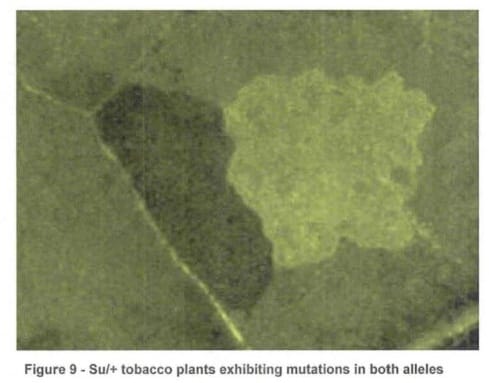
In particular, I liked what they did with plants. BAASS placed six tobacco plants and six spiderwort plants in the ranch trailer under timed grow lights. The tobacco is a transgenic line heterozygous for the Sulfur mutation: the plants are pale green, and if something mutagenic knocks out one allele in a cell you get a dark green spot on the leaf; if it hits the other, you get an albino spot. You count spots. Spiderwort does the same trick with stamen hairs, which flip from blue to pink under a microscope when the dominant color gene gets hit. These are real, peer-reviewed bioassays for radiation and mutagens, and they cost almost nothing. I like the low-tech environmental monitoring approach: no devices, no sensors, no batteries to worry about. It is the very definition of low-touch background monitoring.
They also set up a seed germination trial, 49 snap peas and 49 green beans in each of three locations with a control set back in Las Vegas, and installed seven Moultrie trail cameras with the memory cards pulled weekly.
Unfortunately, the released document is a status report, not a results report. The April visit it describes was "too soon" to read the plants, the seeds in the germination trial hadn't sprouted, and the cameras hadn't captured anything. Every instrumented test ended with a status of "pending," with one exception.
The Skinwalker was a dog
A mere two days before the BAASS team arrived, a witness reported that his dogs had chased a "Skinwalker" through his barbed-wire fence, and that it moved "like a track star."
An investigator walked that fence line and found a tuft of fur caught on a barb. This is the best evidence in the entire report: a specific claim was made, a physical trace was found, there was a chain of custody, and a lab did the analysis. Four samples went out for mitochondrial DNA sequencing on April 2: the fence hair, some white hairs from the same fence, a control sample from one of the witness's own dogs, and a hair embedded in a red-stained rock found on the ranch mesa during an earlier visit.
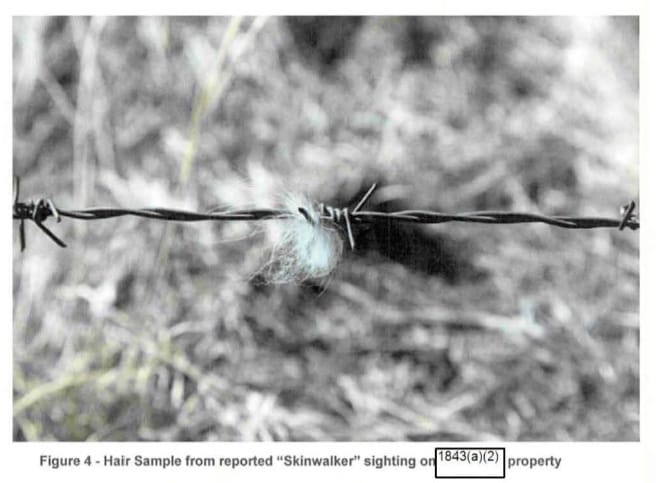
The results came back April 27. The fence hairs and the control dog shared the same canine hypervariable sequence, one found in about 10 to 14 percent of random dogs. Since the witness's dogs "run at will on the property," BAASS's own biologist concluded the hairs almost certainly came from the same animal. The hair in the rock was a raccoon.
To their credit, they reported the results and didn't bury them. A common pattern I've seen in sources I've investigated is the "file drawer" problem: to make high-strangeness claims more sensational, the mundane outcomes get filed away and never mentioned.
The science showed that the Skinwalker that ran like a track star was, in actuality, a dog running like a dog.
In the report, eleven witnesses described encounters with a dog-like creature. Here's how they described it: black fur, red fur, white fur, no fur. Wolf head, human head, pig snout. Six feet, seven feet, eight feet. Sulfur smell, wet-dog smell, no smell.
I think you can probably already spot the issue here.
BAASS had a solid method for collecting this data. They used a single questionnaire for all the witnesses, and the appendix of the report contains tables with all the answers side by side. What those tables clearly show is that everyone described something different, even though they were all talking about the same local legend. How can this be the same creature?
I don't think this is a question of people making stuff up. A lot of it has to do with the context of the witness. Different perspectives come from different personas: a rancher sees a wolf, a Ute elder sees a Skinwalker, a four-year-old sees a kangaroo.
I'm familiar with this because I saw this EXACT pattern when I set out to build a taxonomy of UFO sightings from NUFORC reports. The first thing you learn is that the raw descriptions don't cluster around objects; they cluster around the vocabulary the witnesses bring with them.
I wrote about how I tried to work around that in Classifying the Unknown: A Taxonomy of 152,000 UFO Sightings. If BAASS had run those spreadsheets through the same kind of ontology, I'm fairly certain the eleven different dog creatures would collapse into two or three, and maybe one of them would be named Fido.
Dear reader, as you can tell from what we cover, we don’t write for a search algorithm, and we don’t run ads of any kind. That’s because, with AI, the web business model we’ve all known and loved is broken. We think a subscription is the fairer deal, so if you get something (anything) out of these articles, consider becoming an Insider. A tip or a share helps too.
If headlines are more your vibe, our sister site enigmaticnews.com collects the day’s paranormal, UFO/UAP and high-strangeness stories from vetted sources, curated by a person and updated daily.
Thanks for reading, and for keeping this site going!
Read next

Reimagining the Spirit Box
A ghost hunter’s spirit box, rebuilt so every word it speaks comes with the odds of saying it by chance.

The $40 Toy and a Mind Matter Mystery
Can your mind move plasma? A 2023 study says the streams inside an ordinary plasma ball shift when someone aims intention at it, from inside a sealed chamber, at 1-in-17-million odds. I'm replicating it in my basement. Here's why it's worth a serious look.

Do we really need a Valdivia Sphere Too?
The Buga sphere was the premiere. The Valdivia sphere is the sequel nobody asked for. A breakdown of the 5-step credibility laundering pipeline damaging the UFO field.

Analyzing UFO Sightings Databases with Generated Code
Using generative AI and natural language processing on multiple UFO sighting databases, we finally have the tools to answer questions like Hynek first posed in 1972
