This week: Navy's massive Scott Bray UAP email dump, Grusch's "beautiful dead aliens" claim, mystery over a destroyed US spy satellite, new Noah's Ark site drilling results, and a North Sea dive that may debunk a medieval legend.
Top stories: Pentagon's new UFO document release, a massive cache of Scott Bray UAP emails, and questions swirl around a "never-before-seen" DoD video that actually aired in 1956. Plus Galileo Project triangulation results, Tutankhamun hidden-chamber evidence, and Mothman's 60th anniversary.
Top stories this week: the Pentagon's new UAP waiver and what it may unlock, Ross Coulthart on nonhuman intelligence claims, a peer-reviewed out-of-body-experience study, and a deep dive into a Cold War nuclear security mystery.
Can your mind move plasma? A 2023 study says the streams inside an ordinary plasma ball shift when someone aims intention at it, from inside a sealed chamber, at 1-in-17-million odds. I'm replicating it in my basement. Here's why it's worth a serious look.
This is a weird one. I recently picked up Dr. Dean Radin's excellent new book, The Science of Magic (2025), and tucked away in it was a short mention of a mind-matter interaction (MMI) experiment using a toy plasma globe.
By plasma globe, I mean exactly what you might be thinking of: the toy you can find at Spencer's, a mall kiosk, or a museum gift shop. The one where bright colored plasma tendrils emanate from the center bulb out to the glass perimeter. And when you touch the glass, the tendrils meet your finger from the inside.
Here's the eyebrow raising hypothesis of the study in a nutshell:
Plasma streams in a freely operating ball behave differently when intention/attention is focused on it vs. withdrawn.
What was done
In three exploratory experiments, Radin and Anastasia asked whether the streams inside an ordinary consumer plasma ball behave differently when someone focuses attention or intention on it, using a webcam pointed at the ball as the measurement device.
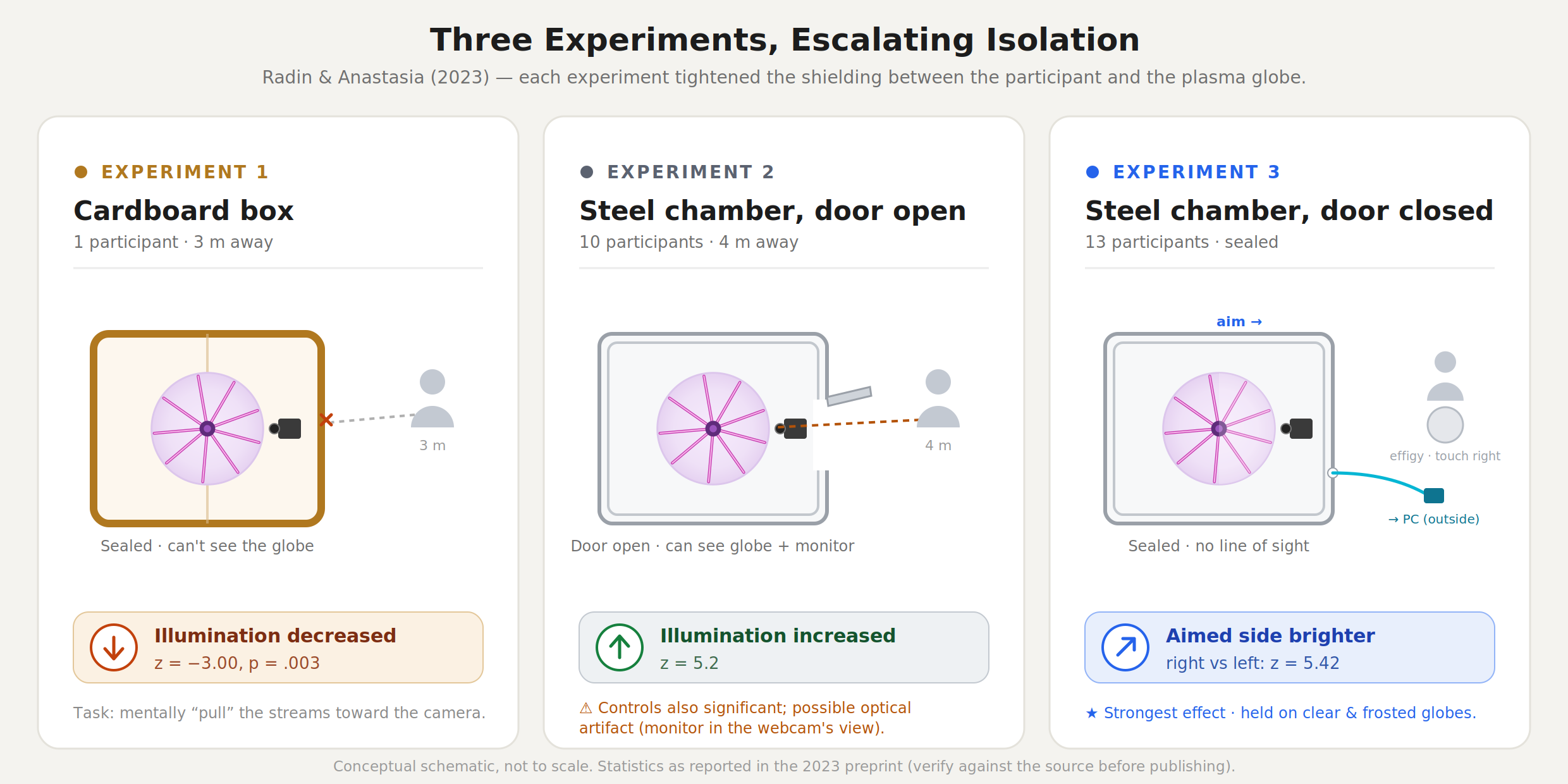
In the first two experiments, they observed that the brightness of the captured images shifted during 20-second "concentrate" epochs versus "relax" epochs. They saw two strange results: brightness decreased in the first scenario (a single participant, with the globe sealed in a cardboard box) and increased in the second (ten individual participants, with the globe in a steel EM-shielded chamber, door open so they could see it). Oddly, the control sessions in the second experiment were also statistically significant, and the authors themselves flagged a possible optical artifact that might have influenced the results.
The third experiment had the strongest design. This time the shielded chamber door was closed and the globe was the only light source. Participants "aimed" intention at the right side or top of the ball, and the camera image was reported to be significantly brighter on the aimed side.
The effect was strongest for the right condition (z = 5.42) and appeared on both a clear and a frosted globe. The authors conclude only that plasma "may be reactive to distant attention and intention," describe the work as exploratory rather than confirmatory, and call for follow-up. Which is where an opportunity for replication comes in.
OK. As regular readers of my site probably know, this is right up my alley.
First off, a z = 5.42 effect is super intriguing. That's essentially 1-in-17-million odds of seeing a deviation that large from pure chance. This got my attention. It doesn't prove that participant intention was the cause (it was a small study, and it could have been some other unknown or overlooked artifact), but it is an eyebrow raiser.
Secondly, my absolute favorite types of experiments involve mind-matter interaction with random physical systems. I've done experiments in the past with hardware-based random number generators. Two examples: plant "intention" skewing randomness, and using intention to influence a robot's movement.
Lastly, this is something I immediately knew I could replicate, and perhaps even improve on the protocol. I mean, the principal component is an off-the-shelf toy plasma globe...
Why plasma?
The real question, though, is why this experiment would even have been attempted in the first place. Why plasma? It turns out there's a 50-year lineage here. I had no idea.
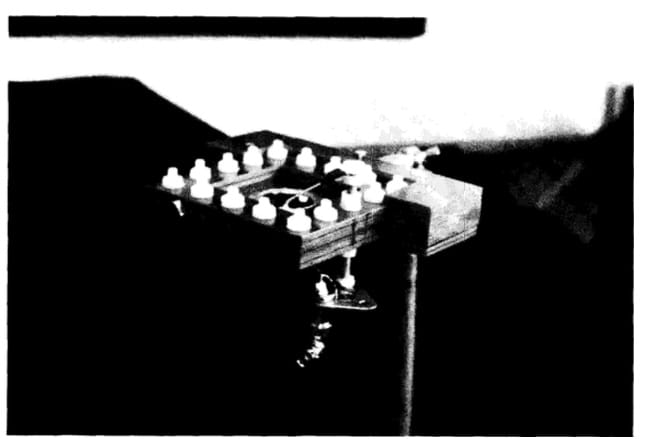
Back in the 1970s, William A. Tiller, professor and one-time chair of Stanford's materials science department, built a small gas-discharge cell: low-pressure gas between electrodes, held at a voltage just below electrical breakdown. In that state, the gas produces tiny electron cascades called microavalanches (the thing that happens right before a visible discharge forms), and Tiller's electronics counted them. He had subjects place their hands around the device, or later simply focus their attention on it, and let his counter record any activity.
In a 1990 paper published in the Journal of Scientific Exploration, Tiller claimed that the microavalanche count rose sharply when focused human attention was directed at the device, and that subjects could either boost the activity or leave it unchanged at will. Similar to Radin's approach, RF shielding eventually entered the picture: in Tiller's later accounts of this work, the participant and the device were placed in separate Faraday cages about 15 feet apart. His interpretation, in part, invoked the role of "human energy fields." Take that as you will.
Radin, for his part, had more than a passing interest in plasma himself. In the mid-1990s he ran pilot experiments using photodetectors aimed at plasma, saw something suggestive, but shelved the work on the assumption that an artifact was influencing the results. Around 2005, he tried again with a webcam, and shelved it again. What finally moved it off the shelf was another precedent experiment.
In his 2023 paper, Radin references a 2021 report by Gary Schwartz at the University of Arizona describing plasma-ball responsiveness to intention, and credits it as the prompt to revisit his own abandoned attempts with a better protocol.
All of this still leaves the question: why look at plasma for mind-matter intention experiments at all?
My take is this: if we're willing to entertain that intention influences matter at all, a "near-threshold" plasma device is among the most sensitive detectors you could put on a lab bench. By near-threshold, I mean a system with a tipping point. Below the tipping point, nothing visible happens. Above it, the system commits to a large, self-sustaining response (the plasma tendrils). Right at the edge of that tipping point, the system is precariously balanced. A microscopically small event, like one electron in the right place or a tiny change in the surrounding field, is all it takes to go from "nothing" to a full visible cascade. So perhaps the plasma globe acts as an intention amplifier. Or, just as plausibly, a false-reading and artifact amplifier. This is why RF shielding protocols are so important.
It's interesting that in both Tiller's and Radin's work, the shielding and isolation protocols evolved over time. Tiller used two Faraday cages, and Radin's later experiments put the ball in an electromagnetically shielded chamber at the Institute of Noetic Sciences: a double-walled, solid-steel room, the same type of modular steel-panel room sold for MRI suites, EMC test labs, and secure government facilities.
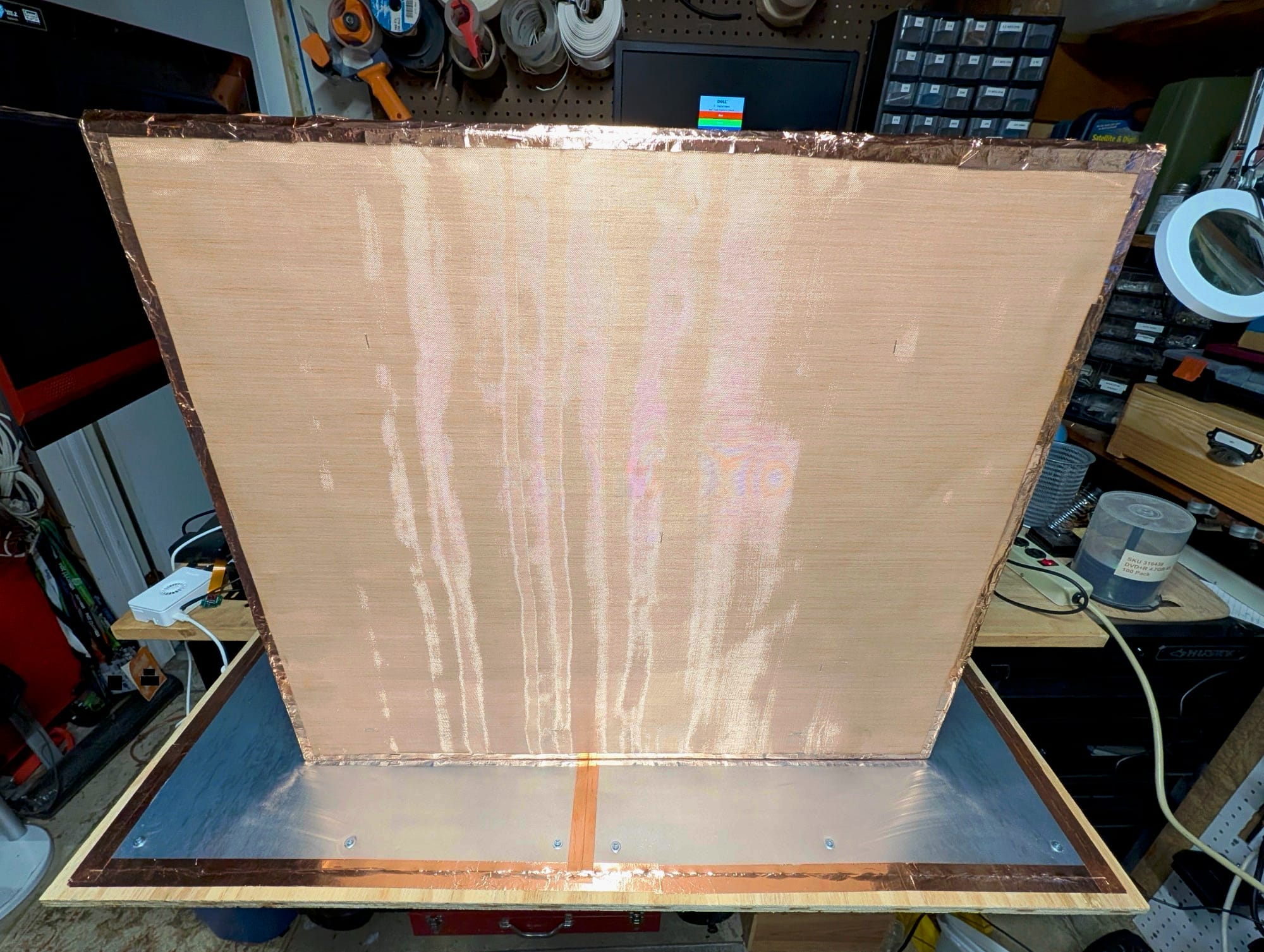
Obviously, if I'm going to attempt a replication, I won't have access to an industrial-scale shielded room. I can, however, build a Faraday cage. (I've always wanted to build a Faraday cage!)
Conclusions and caveats
Given that I intend to replicate this, I thought it would be prudent to elaborate on what Radin and Anastasia concluded, along with the caveats.
As I mentioned above, the stated conclusion is a modest one: plasma "may be reactive to distant attention and intention." Several caveats were also stated in the paper:
The work is exploratory, not pre-registered. All tests were two-tailed because the direction of any effect was unknown (i.e., would intention brighten or dim the captured globe images?).
They offer no explanation for Experiments 1 and 2 pointing in opposite directions. Let me explain: in Experiment 1, Radin's task was to mentally "pull" the streams toward the webcam, with the explicit goal of increasing the measured brightness. The result was statistically significant, but in the wrong direction. In Experiment 2, participants were also trying to increase illumination, and this time it went up. Strongly (z = 5.2). But remember, this is the same experiment where the controls were also significant and the authors suspected the monitor artifact, so that number carries an asterisk. So across two experiments testing the same hypothesis, applied intention produced opposite outcomes that were both significant. This is exactly why the z = 5.42 from Experiment 3, with its closed door and stronger design, is the number that really matters.
They acknowledge a possible optical artifact in Experiment 2: monitor brightness was changing within the webcam's line of sight, which could have influenced the results.
They present three theoretical mechanisms for the effect (vacuum permittivity, plasma as a random physical system, and warm gas rising to produce an upward bias) as speculative.
I have a few additional thoughts of my own after reading the paper:
There's a discrepancy in the reporting for Experiment 1. The abstract reports z = −2.7, p = 0.007; the results section reports z = −3.00, p = 0.003. Likely just an oversight.
The paper doesn't detail how the webcam's auto-exposure, auto-white-balance, or frame timing were handled. These are exactly the settings that matter for an illumination metric.
Lastly, each real session in the third experiment had a paired control session, recorded right afterward with nobody intending anything. But instead of using those controls as an independent sanity check, the analysis consumed them: each control's brightness map was subtracted from its real session to cancel out the ball's natural bright and dim spots. Ultimately this means the controls are baked into the result rather than standing next to it, and anything that drifted between a session and its paired control (a warmer ball, a slightly different camera state, etc.) shows up after subtraction looking like an effect.
Thinking about that last point, when I attempt this experiment I want to try a different approach: record a few control sessions and then analyze them exactly as if they were experiments. I'll assign a real condition schedule (aim right, aim top, etc.) but with nobody actually participating, and then use that as a comparison against the actual experimental runs.
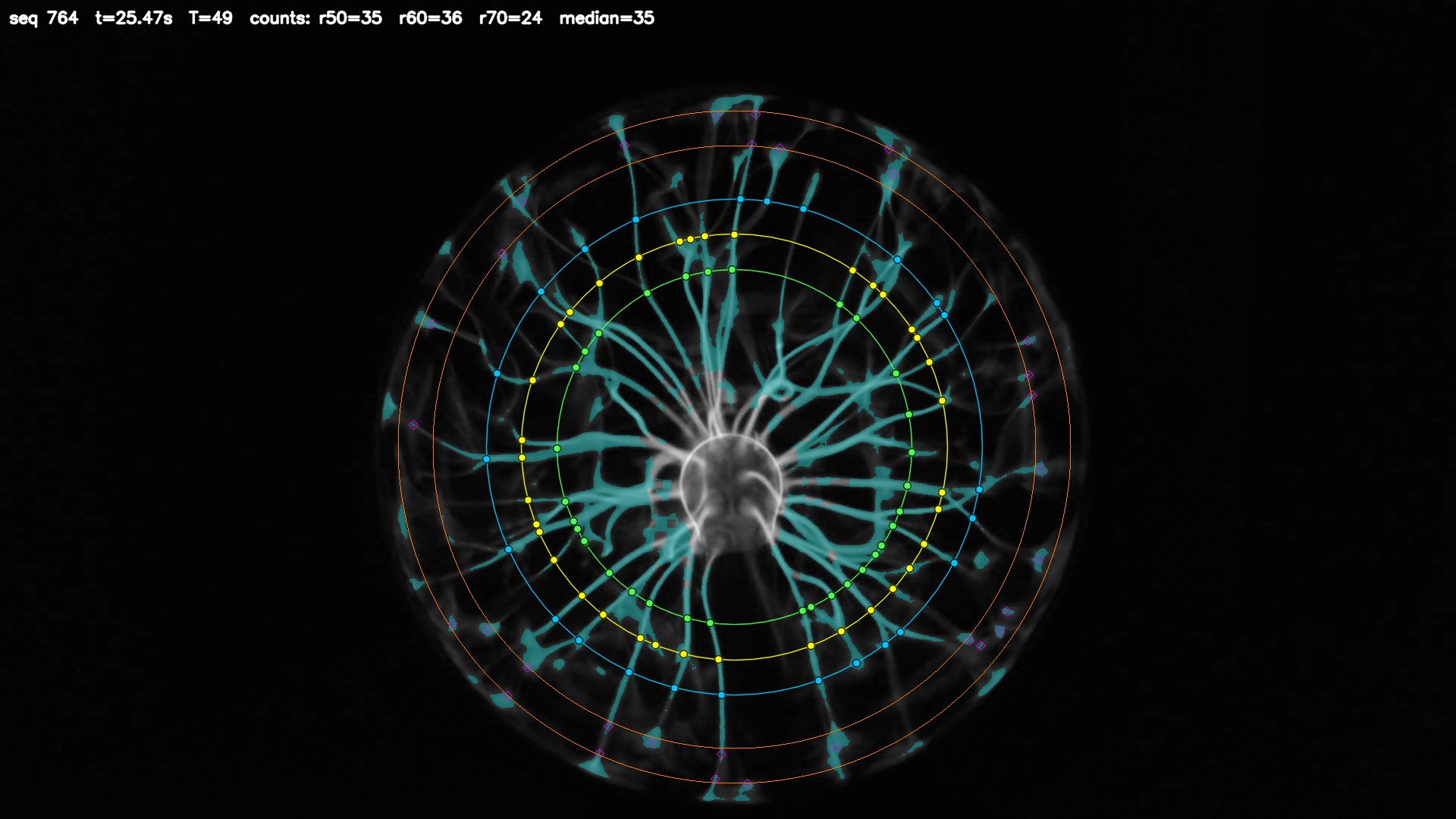
Also, I'm going to try an additional level of resolution. Instead of just calculating the mean brightness of the image, I'll see if I can actually count the individual tendrils over time. The hypothesis being that "aim right" should mean more tendrils on the right side of the globe than on the left.
Lastly, I want to be clear on where I stand with this. I'm a real fan of Dr. Radin's and I've read almost all of his literature. But I'm not trying to prove him right, and I'm not trying to debunk anything either. I intend to find out what my camera actually sees. If there's a real directional effect, that's awesome, and that will be the story. If it flat-lines, or if an "effect" shows up even when nobody's intending anything, I'll report that too. It wouldn't be the first time I've reported a null result. With what I do, that's more typical than not.
If you have thoughts about this experiment, let me know! At this point I have the rig essentially built and I'm currently in the testing phase. Stay tuned, as I'll be reporting back with both my results and my build notes in upcoming posts over the next few weeks! Here's a teaser image of my setup. Faraday cage!
Dear reader, as you can see from the types of topics we cover, we do not write for a search algorithm and we do NOT display ads of any kind. That's because, with AI, the web business model that we've all known and loved is broken.
We believe that being subscription based is a more equitable model, so if you like our content, please consider becoming an Insider to keep this site going! Also, if you enjoyed this article, please consider leaving a tip or sharing it on social media. Thank you again for your support and readership!
Using generative AI and natural language processing on multiple UFO sighting databases, we finally have the tools to answer questions like Hynek first posed in 1972
175 strangers filed independent reports about the same thing. 96% agreed on the color. 100% agreed on the sound. I ran the data on the Tinley Park Lights.
I claimed triangles are nocturnal. That disks are 5x more likely to involve entities. That shadow beings terrify while light beings inspire awe. Here's the sighting ID index so you can verify it yourself.
I analyzed entity encounters in the NUFORC sightings database. Shadowy beings: 68% of witnesses report fear. Greys: 38% involve abduction. Light beings: more awe than fear.