
Reimagining the Spirit Box
A ghost hunter’s spirit box, rebuilt so every word it speaks comes with the odds of saying it by chance.
A ghost hunter’s spirit box, rebuilt so every word it speaks comes with the odds of saying it by chance.

During a quiet night in my lab, with no one else home, my new little device spontaneously announced "AQUIFERS", "PAW" and "BEERS". Jarring, because earlier that same day I had taken my dog for a stroll around our local reservoir and stopped for lunch and an IPA.
That's a creepy coincidence. And what are the odds? Well, here's the thing: I know EXACTLY what the odds are, and honestly, that makes it even more creepy, not less. (About 1 in 12 million for AQUIFERS alone, and I'll run through the math in Part 2 of this series.)
What did I build? A completely revamped version of the venerable spirit box of ghost-hunter fame, just in time for Halloween. I wanted to do this because: 1) I thought it was time to revisit the underlying premise given the tech readily available in 2026, and 2) I had most of the parts, and it would be relatively quick to get done in time for the holiday.
"The Decker Device"
Here's what I did.
I mounted a Raspberry Pi 4B in a hinged plywood box, running on a battery. Two machine screw heads in the top wall act as antennas, connected to analog-to-digital converters, and there is a small OLED display and a speaker. On the lid are two toggles (POWER and AUDIO) and a wake button. The device runs about 6 hours on a charge.
The Pi reads the electrical noise on the screws about 700 times a second per screw. It turns the noise into a stream of letters (several hundred per second) and then searches the stream for words using an approach similar to the Bible code. An algorithm then determines whether a word should be selected based on how far it exceeds chance. When a word is selected, it's displayed on the screen and spoken out loud. The algorithm selects a different voice for each word spoken.
Key to this project: no software random number generator is used anywhere. Every letter and every voice ultimately comes from the antennas. The one minor exception is that the speech engine adds a little internal variation to how a voice sounds.
When the device runs, everything is recorded: every antenna reading, every letter and every word, with timestamps. A session can be replayed exactly for later analysis.
Here are a few examples of the output. These different modes occur during a field session.
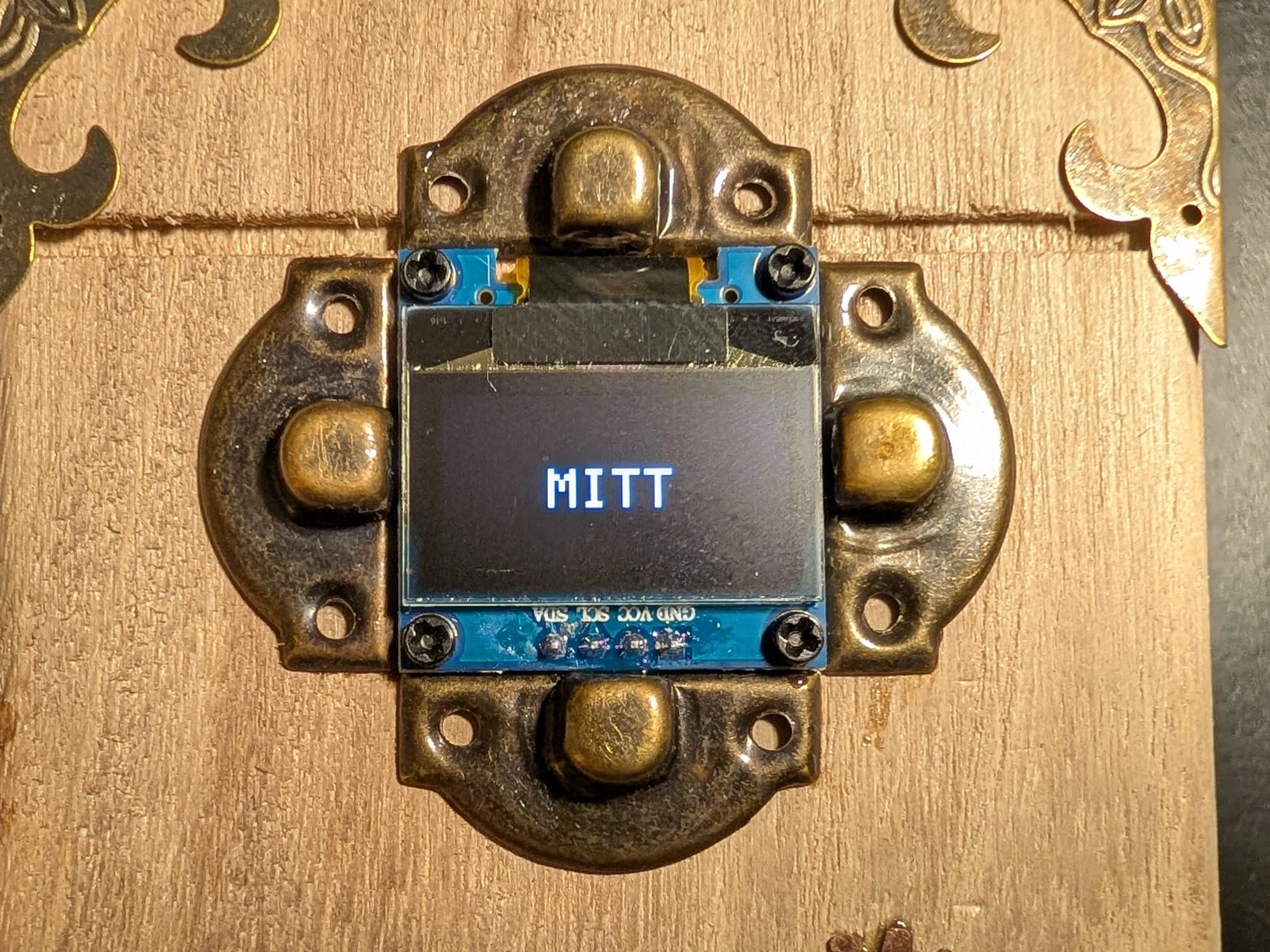
First, a discovered word, "MITT". To be spoken, MITT had to appear four times inside about 21 seconds, all at the same spacing (every tenth letter) and in the same direction. Chance puts a given 4-letter pattern in a single reading about once every 26 windows (21 seconds each), so four in one window is roughly a one-in-12-million event.
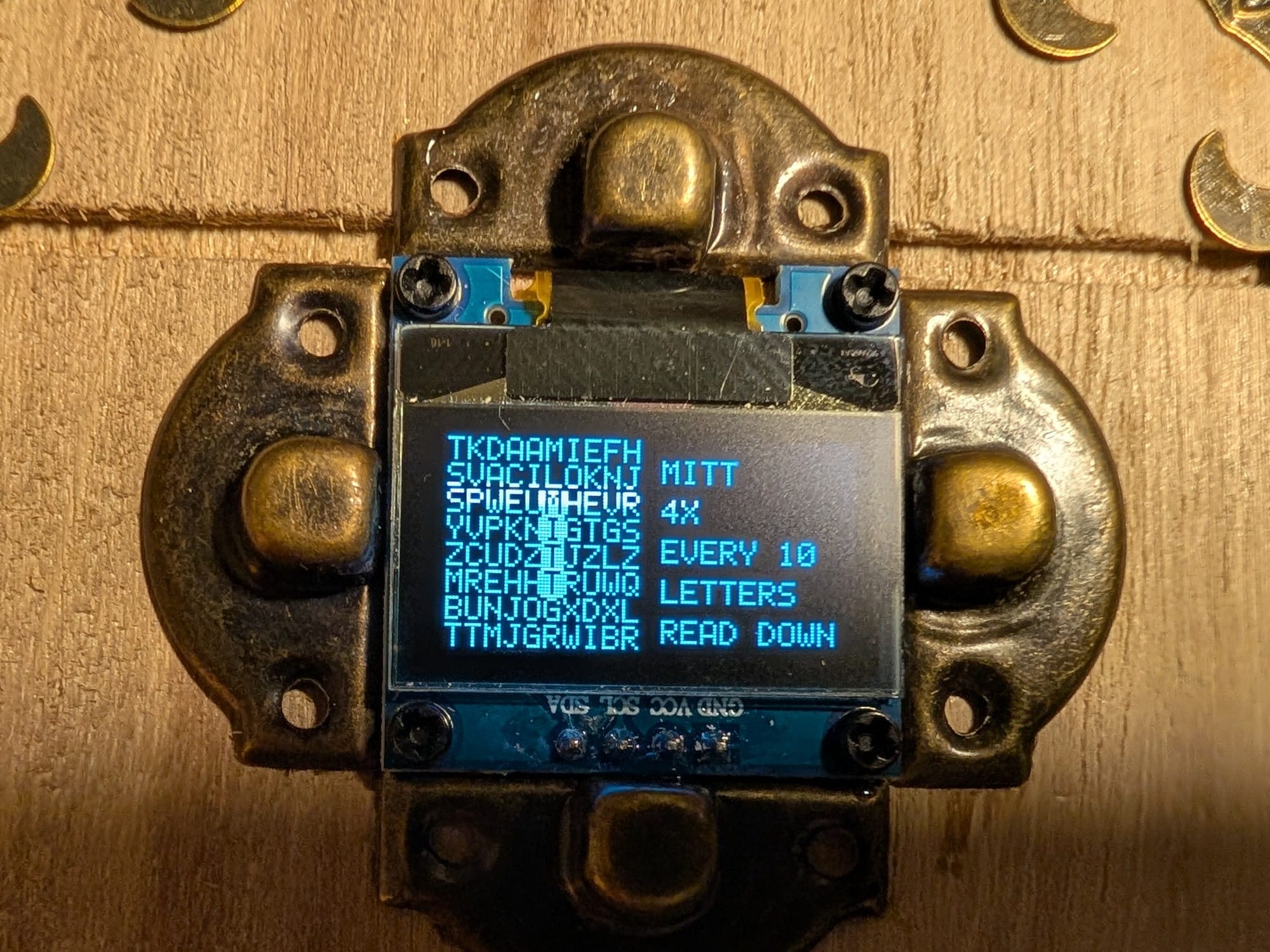
This next display shows the "evidence" of why a word was spoken. How many times it occurred, and the specific "Bible code" rule that found it.
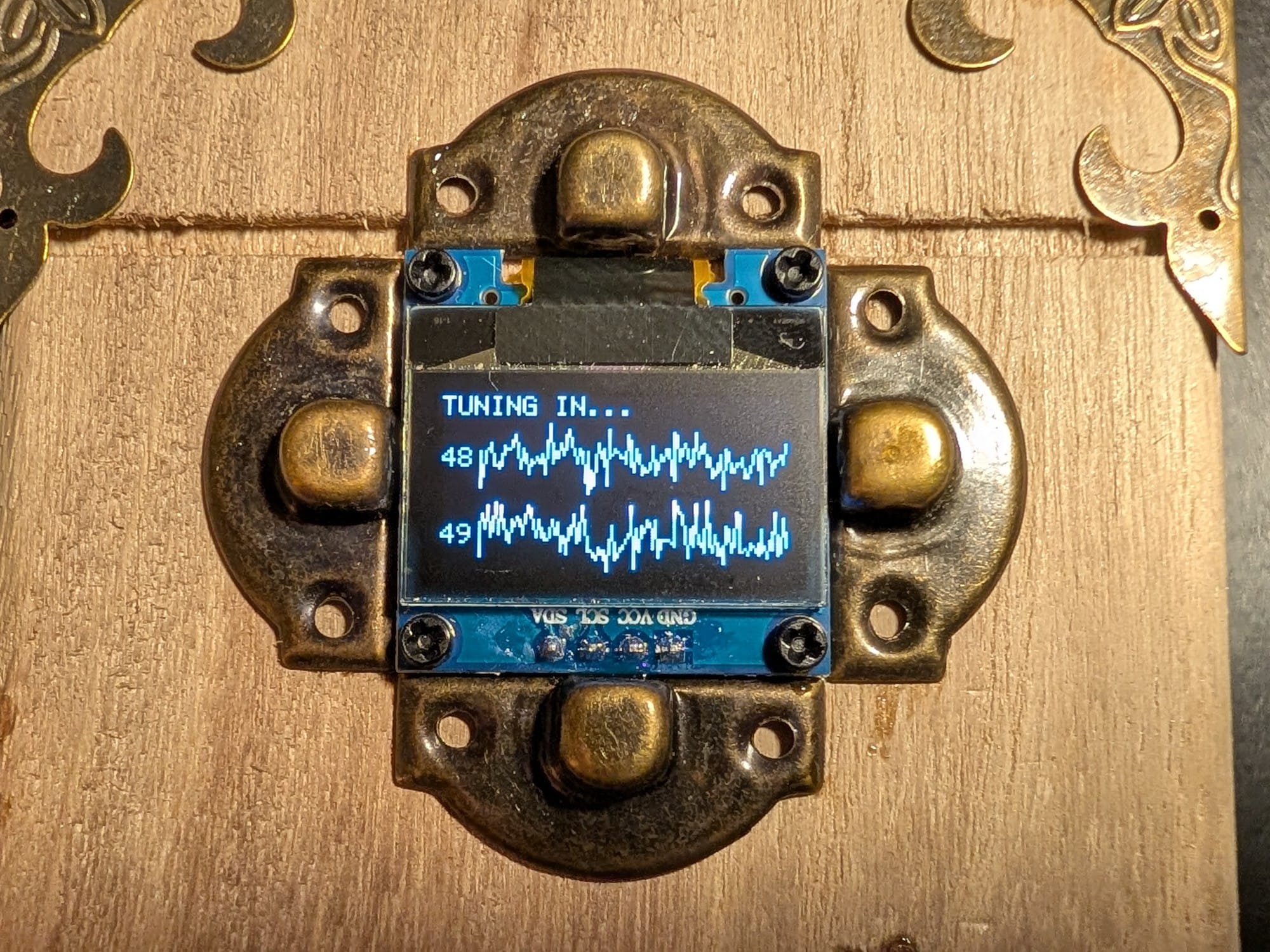
This next mode shows the output of the antennas. 48 and 49 represent the analog-to-digital converter I2C addresses.
No software random number generator anywhere. Every letter and every voice comes from the antennas, and every reading is kept.
That’s the high-level summary. I’ll go deeper in the next articles. But before the why, some history, because I think of my box as the next step in a line that runs through everything on this list.
The term "spirit box" dates back to about 2002 (Frank's Box was the original) and describes one of several types of devices that swim in the larger lake of Instrumental Trans-Communication (ITC), meaning devices that purportedly "communicate" with spirits or other discarnate entities.
The genesis of the idea goes further back, to the late 1950s, when people began hearing voices in recorded birdsong. What's interesting is how the approaches have evolved over time and the differing technologies used (including my device, which I believe takes a novel approach). When categorizing these devices I found it easiest to think of them in terms of "what's the input", "what's the output" and "who deciphers it". The list below summarizes the progression, and I've included my build as the last row.
Examples: Jürgenson (1959), Raudive (1971)
Input: tape hiss, birdsong, inter-station radio static, the hiss of a diode
Output: a recording with sounds that might be voices
Who deciphers it: the listener's ear, replaying the tape
What ghost hunters call it: EVP, graded Class A, B or C by how clear the "voice" is
Note: Years ago, I replicated one of Raudive's diode detector devices and created a short video overview.
Examples: Frank's Box (about 2002), P-SB7 (2009), EchoVox, EVPmaker
Input: transistor noise driving an AM tuner; a timer sweeping the dial; random numbers picking from a sound bank or a chopped recording
Output: short bursts of real human speech, from broadcasts or recordings
Who deciphers it: the listener, live, stitching fragments into a reply. The device only decides timing
What ghost hunters call it: spirit box, ghost box, "the SB7"
Examples: Paranormal Puck (2008), Ovilus I through X, Spirit Story Box app
Input: EMF, temperature and ionization readings; undisclosed for the app
Output: one word from a fixed list, spoken by a synthesizer or shown on screen; a whole sentence from the app
Who deciphers it: a hidden mapping picks the word. The listener supplies the meaning
What ghost hunters call it: word generator, "the Ovilus", ITC device
Examples: K-II, Mel meter and other EMF meters
Input: the local electromagnetic field
Output: lights, or a needle fluctuating
Who deciphers it: the ghost hunter (through the idea that spirits move fields)
What ghost hunters call it: EMF detector, "K2"
Examples: Spiricom (1982)
Input: thirteen audio tones mixed together and broadcast continuously
Output: a continuous buzzing voice holding conversations. (Note: critics have identified the buzzing voice as an electrolarynx, the battery-powered speech aid used after a laryngectomy.)
Who deciphers it: the operator
What ghost hunters call it: Spiricom (as a historical reference; the term isn't really used)
Note: George W. Meek, who funded the project, gave away the technical specifications in 1982. The manual is still online, and warns that building one without a “highly charged human energy field” in the loop may waste your money. Nobody else ever got it to work, including Sarah Estep, the founder of the American Association of Electronic Voice Phenomena.
Examples: PEAR (1979 to 2007), Global Consciousness Project (1998 on), Schmidt
Input: electronic noise or radioactive decay, debiased, with a person using mental intention to influence the output
Output: a count of ones against zeros per trial, compared with chance. Never a word
Who deciphers it: the experimenter, with a statistical test fixed before the run. Nobody hears anything in this case
What ghost hunters call it: not ghost-hunting gear; "PK experiments", "the Princeton machine"
Note: I included this "tangential cousin" even though it's not an ITC device, because the technique it uses is at the root of my design. Read on below.
Examples: the box described in this article series
Input: random electrical noise on two screw heads acting as antennas, debiased and digitized into a string of ones and zeros, then converted to letters
Output: words spelled letter by letter from the noise, selected by fixed algorithms, then spoken; plus a separate presence alert with a stated false-alarm rate
Who deciphers it: a word is spoken only when its repetition in the noise would happen by chance about once in a million tries, and that number was set before the box ever ran. The operator is responsible for discerning any "meaning".
What ghost hunters call it: Nothing yet. :) I'd prefer "the Decker Device".
Let's dive into the "why" behind using electrical noise for ITC. I'm not asking you to believe this, but consider this chain of ifs:
If spirits exist, if they can affect electromagnetic fields (the premise under every EMF meter and sweeper), if they're able to talk, and if they're willing to talk, then noise is likely where they would do it. Perhaps a mighty ethereal effort is needed for even a subtle push or nudge of the electromagnetic field.
Now consider the design problem this introduces. Any subtle nudge of the field is going to look like every other mundane nudge the box already senses: noise from nearby electrical devices, the internal amplifier switching, a hand near an antenna screw, the box's own processor. A real device has to cancel out deviations like those, or it will invent words out of its own wiring. But that cancellation risks erasing the spirit's influence as well.
So if you take the EMF premise seriously, you're stuck. Leave the bias in and the box is lying. Remove the bias and you may have deafened the device to the very effect you're looking for.
Every device in the list above ran into this same dilemma, and each one got past it by stepping around it. The EVP recorders and the sweep boxes shift the problem to your ears. The Ovilus hides it inside an algorithm nobody outside the company has seen. Not one of them has a published baseline. As far as I can find, nobody has run an Ovilus or a sweep box in an empty room for eight hours and reported how many words came out, so there is nothing to compare a "hit" against. That’s the gap I’m attempting to close.
Leave the bias in and the box is lying. Remove the bias and you may have deafened the device to the very effect you’re looking for.
The one group that faced the dilemma head-on was the "tangential cousin" outlined above. Princeton’s PEAR lab and the Global Consciousness Project debiased their bit streams, cancelling any steady lean (exactly the cancellation I just described), and then looked for an effect anyway, with a statistical test written down before each run. Helmut Schmidt, the OG physicist for this line of work, argued that if a mind influences these machines at all it acts on the result, not on the circuitry, so the cleaning costs it nothing. Whether or not he’s right, that is the path out of the dilemma. You don’t have to choose between honest and sensitive. Clean up the bits, state the odds in advance, and record everything so the question stays open.
As far as I can find, nobody has run a spirit box in an empty room for eight hours and reported what came out.
What I wanted was a device that uses the same method that labs like PEAR settled on. Not a box that proves anything. A device where every word arrives along with its odds, where the baseline and rules are written down and locked before the first published session, and where the full record lets you see if you’re deceiving yourself with perceived "meaning" (word-based pareidolia). I suspect there are ghost hunters out there who will appreciate the rigor and the honesty.
How my device does that, and what it said to an empty room for eight hours, is Part 2. For those who would like to replicate this, my complete build plans will be released as Part 3.
Dear reader, as you can tell from what we cover, we don’t write for a search algorithm, and we don’t run ads of any kind. That’s because, with AI, the web business model we’ve all known and loved is broken. We think a subscription is the fairer deal, so if you get something (anything) out of these articles, consider becoming an Insider. A tip or a share helps too.
If headlines are more your vibe, our sister site enigmaticnews.com collects the day’s paranormal, UFO/UAP and high-strangeness stories from vetted sources, curated by a person and updated daily.
Thanks for reading, and for keeping this going!

Can your mind move plasma? A 2023 study says the streams inside an ordinary plasma ball shift when someone aims intention at it, from inside a sealed chamber, at 1-in-17-million odds. I'm replicating it in my basement. Here's why it's worth a serious look.

Using generative AI and natural language processing on multiple UFO sighting databases, we finally have the tools to answer questions like Hynek first posed in 1972


175 strangers filed independent reports about the same thing. 96% agreed on the color. 100% agreed on the sound. I ran the data on the Tinley Park Lights.

I claimed triangles are nocturnal. That disks are 5x more likely to involve entities. That shadow beings terrify while light beings inspire awe. Here's the sighting ID index so you can verify it yourself.