
Reimagining the Spirit Box: Part II
Fifty-seven words uttered in eight hours with nobody home: the first published baseline for a spirit box, and the math behind the three that mirrored my day.
Fifty-seven words uttered in eight hours with nobody home: the first published baseline for a spirit box, and the math behind the three that mirrored my day.

This is Part 2 of three on reinventing the spirit box of ghost-hunter fame.
Part 1 covered the history of these alleged conduits to the spirit world, the different approaches people have tried, and why my "Decker Device" borrows from the PEAR lab playbook. This one is the deep dive: how the box works, and why I think the approach is new.
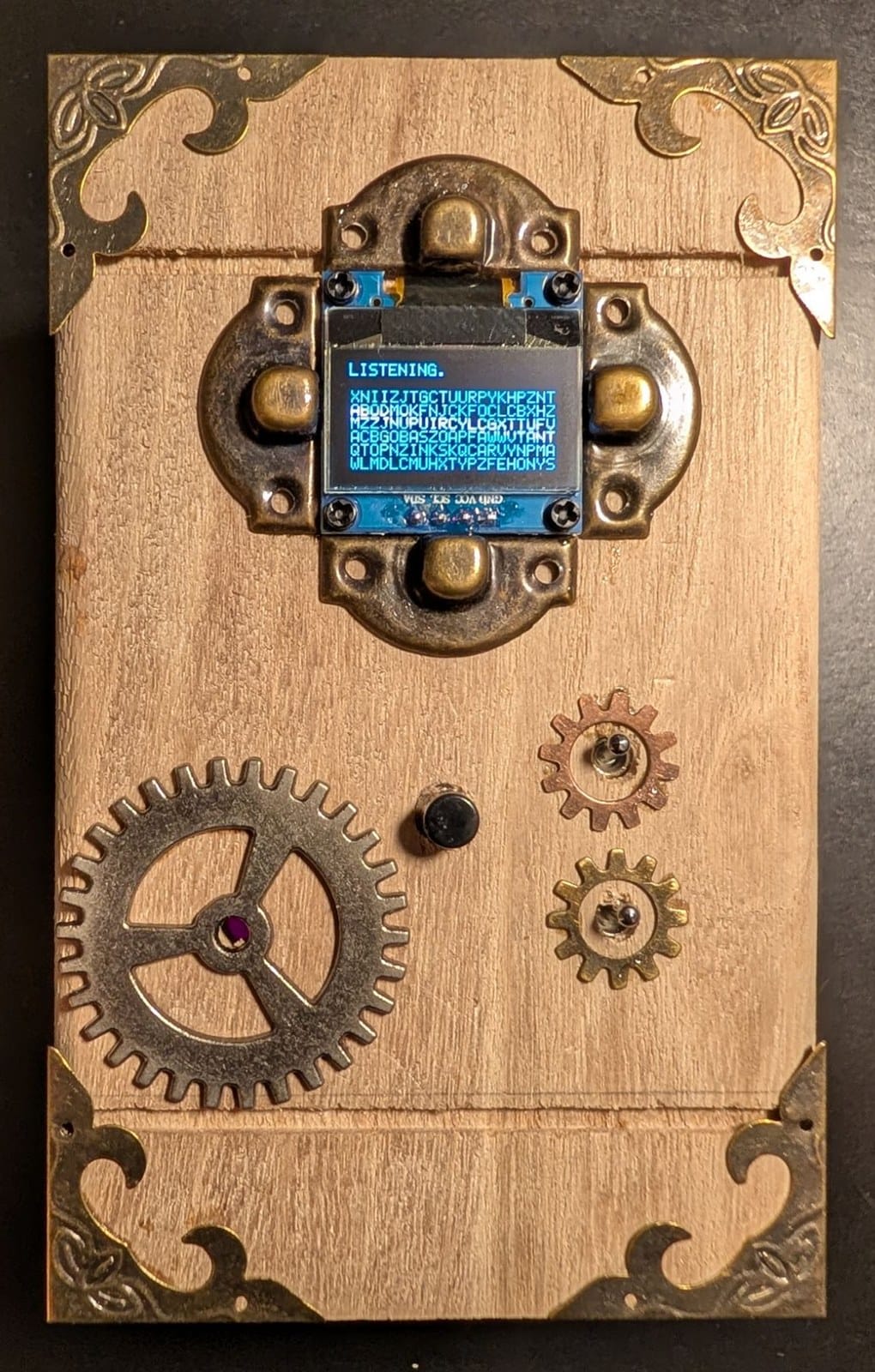
Using One Signal to Answer Two Questions
Ultimately I’m trying to detect a stray eddy of a weak signal in an ocean of electrical noise. You’ll need your suspension-of-disbelief hat here, as with any of this, but the thesis is that ghosts nudge rather than push when phoning home. The problem is that in any setup where random noise is extracted and converted to bits, there’s going to be a lean from the environment and the equipment. By cleaning up, or debiasing, the output, I may well be removing the very nudge I’m looking for. So I need to know two things: 1) are the readings behaving differently from the baseline on a macro scale, and 2) is there a lower-level ordering of the bits that results in the formation of words.
To do this, I created two distinct channels from the same signal.
The first channel is the precision bits that are used to form letters. There’s a lot to it, but in a nutshell: the converter delivers a 16-bit number from the antenna, I keep only the last four binary digits, run those through a debiasing step using a standard algorithm, and convert the cleaned bits to a stream of letters. The result is that every letter generated is equally likely, and over 16.7 million letters the measured deviations were within chance.
The second channel is the presence detector. Here I’m evaluating the antenna output at a more macro level, looking for big swings from a baseline. The baseline is not something the box calibrates when you switch it on. It was set in advance, from 6.7 hours of the box running on battery in an empty room, and the thresholds are hard-coded with the rest of the detection rules. When a session starts, a “tuning in” display (below) is shown for about twenty seconds while the letter window fills, and from then on, if a block of readings crosses a predetermined threshold, an ACTIVITY indicator alerts the operator.
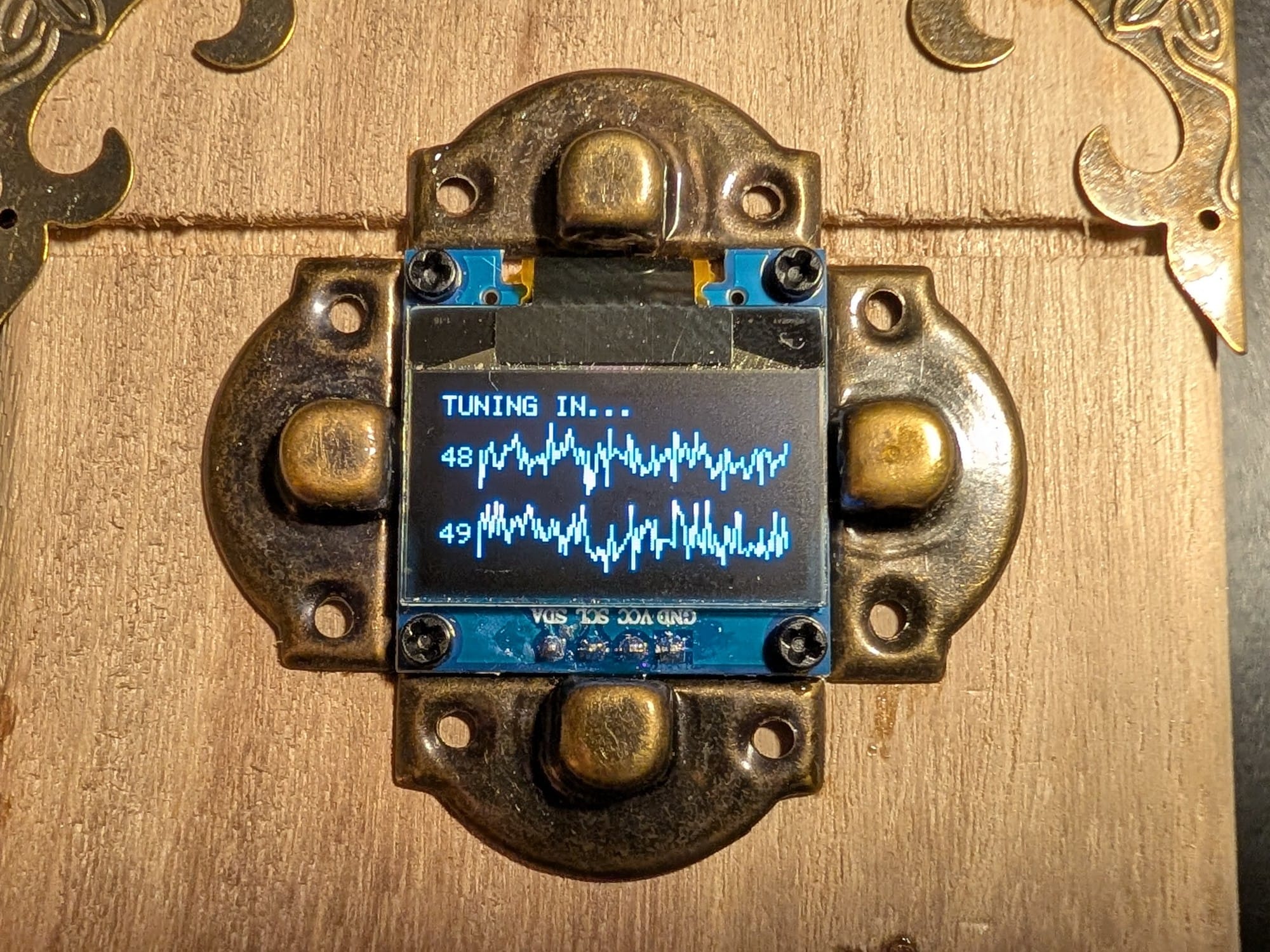
Finding Words in the Matrix
Now that we have a stream of letters, we need to separate signal from noise. Where I landed was an approach similar to what the Bible-code searches did. The scanner reads the letter stream twenty ways: every letter, every second letter, up to every tenth, each forward and backward, looking for exact matches against a 35,000-word dictionary.
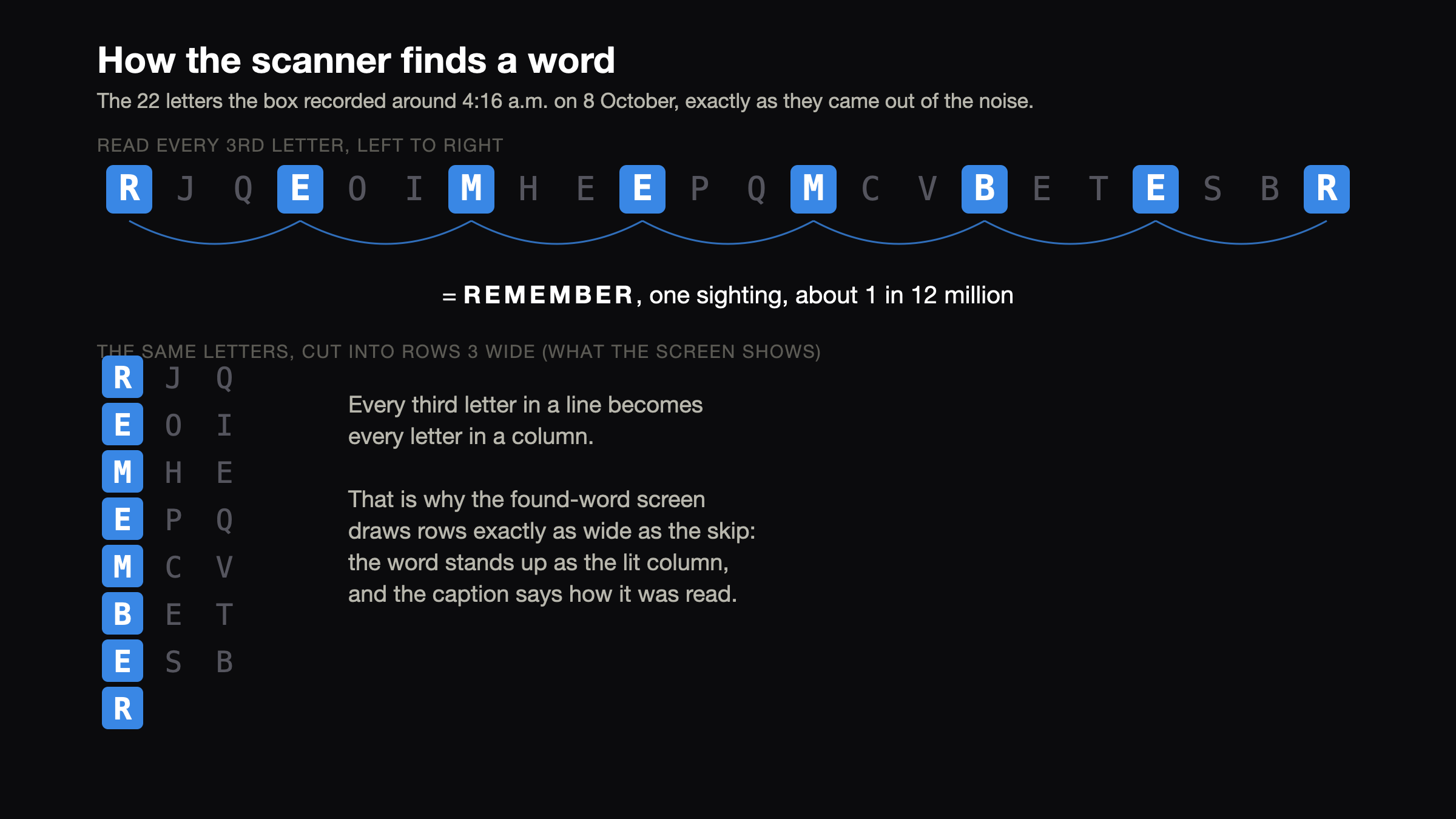
This leads to another problem. Shorter words are much more likely to be discovered than longer ones, and the detection rate would be absurdly high given the continual stream.
To solve this, a word is spoken only when its repetitions inside a window of recent letters (about 17,250 letters, about 21 seconds of listening, re-scored after every block of about a second and a half) would happen by chance about one time in a million. (Repetition means the same word sighted again in the same reading: same skip, same direction.)
I wanted every word to clear the same bar, so the number of repeats needed varies with word length: a 3-letter word needs 9 sightings in 21 seconds, a 4-letter word 4, a 5-letter word 3 within about 2 minutes, a 6-letter word 2 within about 2.5 minutes, a 7-letter word 2 within about 66 minutes, an 8-letter word a single sighting. Nothing is hand-picked.
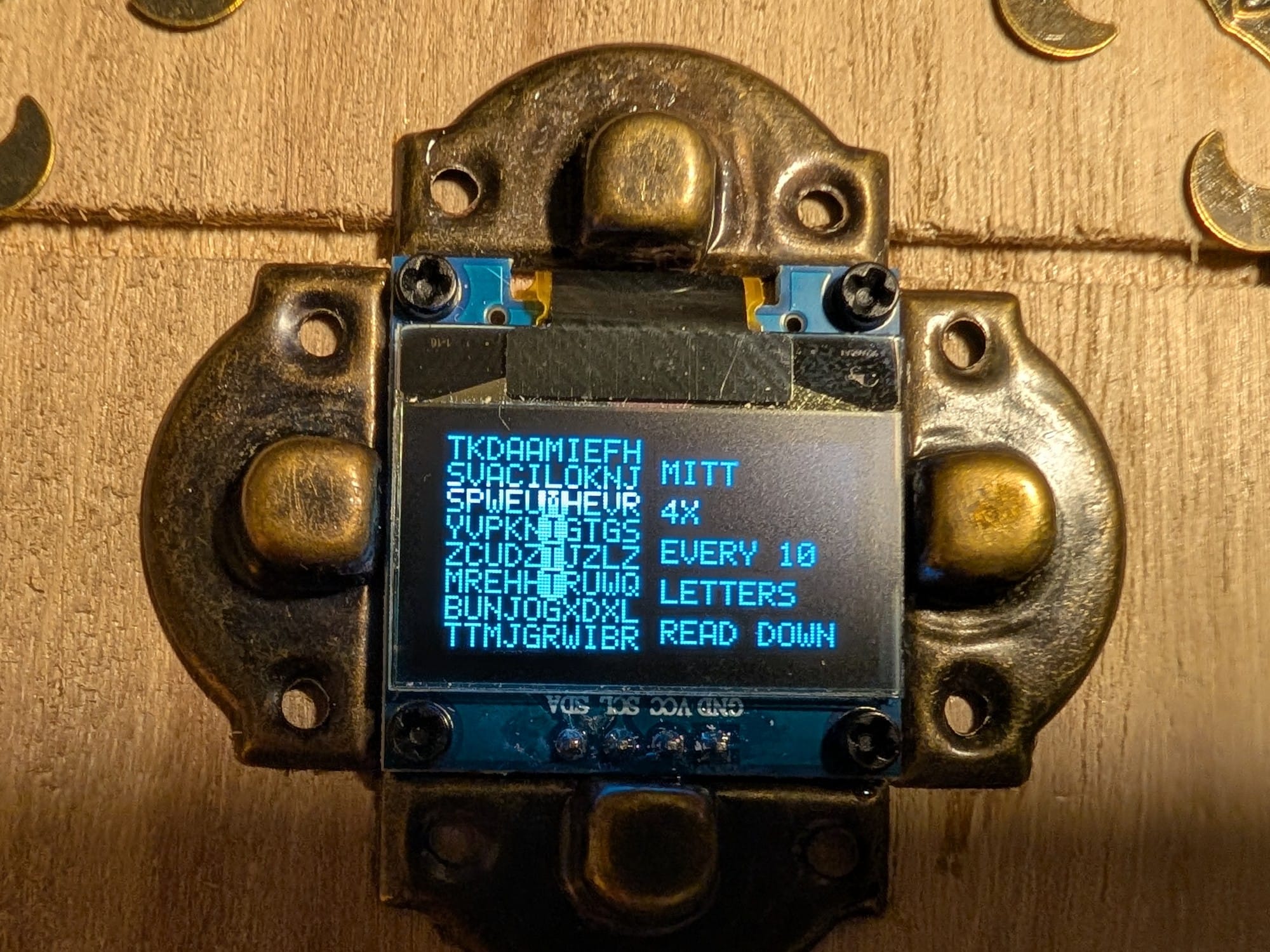
I also wanted to be transparent about how a word was detected and give that feedback to the operator. To that end, there is a screen that states the exact claim (below). Here it shows the evidence grid for the discovered word MITT (“4X EVERY 10 LETTERS READ DOWN”): four sightings at that skip inside the window, the minimum for a 4-letter word. The FOLKLORE hero image is the same screen at full size: the stream cut into rows seven letters wide, the word standing as the lit column.
Yes, there's AI, but Not How You Might Think
Not mentioned in Part 1, but I am using a small language model (SmolLM2, 360 million parameters, running on the Pi itself). Here’s what it’s doing: found words that arrive within about 10 seconds of each other are spoken together. When three or more arrive together, the model’s ONLY job is to say whether they can be read as a phrase, in which case they are spoken together as one phrase, those words only, in that order.
Initially the AI wasn't so constrained. On the first day of testing, with a smaller model and a vague prompt, I gave it three words the device had found ("leave", "light" and "wait") and I told it to speak them as a phrase. What came back was "I'm gonna miss you", "I'm gonna miss you". Creepy, yes. Accurate, no. None of those words came from the antennas. A spirit box with a language model on a long leash is a fiction generator with a spooky voice. This is exactly the kind of device I didn't want to build. So the leash got short.
So ultimately, the model adds nothing, removes nothing and reorders nothing. It sees the words exactly as found, in the order found, and answers just one question: natural phrase, yes or no. If an “at” shows up in a sentence, the box actually found it.
I tested and calibrated this before trusting it. I fed the model 600 triples of chance words and it called 31 of them a phrase, about 1 in 19. In a nutshell, a chance sentence needs two things: three words discovered within 10 seconds (this never happened in 8 hours of empty-room testing), and then a thumbs up from the model, at 1 in 19 odds.
The point here is honesty and transparency. Contrast this with the Spirit Story Box app, whose story engine is undisclosed (the store page says “for entertainment purposes only”).
Everything on this site is paid for by readers, not advertisers. That’s why we can write what we like. Free membership gets you VIP posts to your inbox; Insiders get to see behind the curtain: build docs, lab notes, the code and data.
No Faking It
Most ghost-hunting equipment rewards the operator for rigging the system. Touch the EMF detector’s leads, or set it next to a hair dryer, and you’re going to get exciting results.
I have safeguards. During testing I baselined what happens when you touch one of the antennas (the screws). The result is a rule: any reading pinned at the converter’s limit, or a block of readings swinging far wider than an empty room ever produces (more than 3,000 counts, where an untouched antenna never passed 800 in 6.7 hours), raises an ANTENNA TOUCHED alert naming LEFT or RIGHT. My empty-room overnight had zero pinned readings in 28.9 million, so when this alert fires, it’s near-certain contact. The flip side is also true: the box can’t be gamed with a wave of the hand. Short of nearly touching a screw, a hand, a phone or a person walking past doesn’t trigger it.
From the same baselining I also have a stated false-alarm rate for ACTIVITY: about one per two hours in a quiet room on battery, a target I set before the calibration data existed. The box doesn’t police itself against that rate; it reports every threshold breach and logs the four numbers that contributed to it. But if ACTIVITY lights up four times in an hour, something is going on, and the log is where I’d go to find out what.
I firmly believe in observability. All data is recorded with a timestamp for later analysis: every reading from each screw, every letter, every word discovered, every utterance and which voice said it. A session can be replayed bit for bit through the same code. I borrowed this idea from the Paranormal Puck (2008), which logged temperature, EMF and ionization for every sample and attached the sensor data to each word. I’m taking it further, down to the raw readings.
Lastly, the box tests the state of its own noise continuously. It performs two health checks from the NIST SP 800-90B standard on the raw bit streams. If a bit sticks or skews to a single value, the letters are paused and SIGNAL PROBLEM is displayed.
OK ghost-hunters. What this device is not:
1) It's not evidence of anything by itself. It's an electrical-noise measuring instrument with a stated chance rate and a complete record of readings.
2) It's not chatty. This is by design. It says far less than the devices it replaces, and more silence than words means the device is working.
3) It's not expensive. You can easily build this device yourself for less than $300. In Part 3 of this series (Insiders only) I will provide the complete part list, build notes and code.
Truth time.
I’m now going to share what this box said in a quiet (presumably not haunted) room when I was baselining its behavior for eight hours overnight. As far as I can find, no other spirit box maker has done this, and I’m doing so in the spirit of transparency and to provide a published baseline.
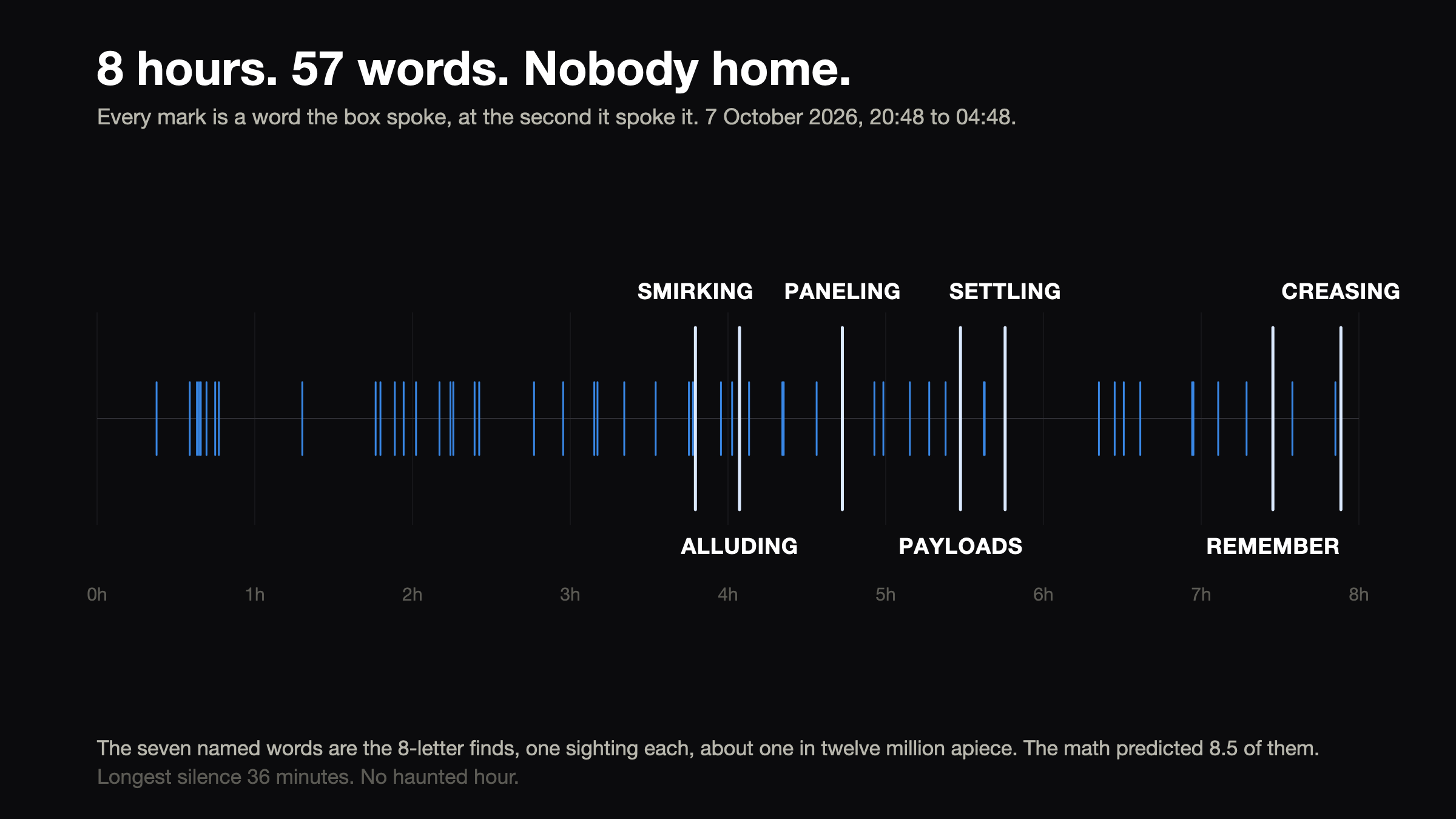
I performed the test with the device on the charger because the battery cannot last 8 hours. During this time I captured 14.5 million rounds of readings (28.9 million individual readings across the two antennas), with zero bus errors and zero maxed-out readings.
The box said 57 words in 8 hours. These are words that met all of the repetition conditions, and they averaged about one every 505 seconds: a steady 5 to 9 per hour. 40 of the 57 were three-letter words. Here is the entire list in order (I highlighted the longer words):
hod, ohs, eat, jog, sax, nit, mold, flu, egg, oats, is, pie, cad, hog, dry, inn, uh, cis, via, art, cud, joy, ivy, hob, any, so, yes, smirking, vet, cox, alluding, cope, ill, jam, web, paneling, was, ado, eve, zeta, meal, payloads, kid, two, settling, fad, pun, web, arc, our, she, dope, fist, remember, bee, mow, creasing
Interesting in that there were 7 eight-letter words where the math predicted 8.5 in that time period, so fairly close to the prediction. The odds for each eight-letter word were about one in twelve million.
The words were relatively evenly paced through the night, so no haunted “magic hour”. Also there were no phrase checks, because there were no candidates for a sentence (three words within 10 seconds).
Ultimately, there were fewer words spoken than predicted by chance (57 vs 86), so if anything, it errs in the quiet direction.
Fun fact: the same scanner code run over Moby Dick (the book used to mock the Bible code), fed at the device’s letter stream rate, finds about 2,300 qualifying words a minute, more than 10,000 times the noise rate. Real language is full of repetition; electrical noise is not.
In Part 1 I described a particularly creepy session where some words spoken were relevant to what I did earlier that same day (AQUIFERS, PAW and BEERS). I said that the chance of the one word AQUIFERS alone occurring was about 1 in 12 million. Here I would like to run through the math. It’s best to think of this in terms of layers.
Layer 1: the actual words.
Here are the odds, under the repetition rules, for the words found:
Layer 2: any word.
Here are the odds overall of discovering some word:
Layer 3: words that have meaning.
This is the point of the whole exercise. What are the odds that a discovered word has some significance?
In my next post (Insiders only), I’m going to provide the complete build plans so that anyone can replicate this device. What will be included:
I sincerely hope that someone else will build one. My box said AQUIFERS while I was walking around a reservoir with my dog, and PAW and BEERS that evening. I was able to calculate how likely that was, but that didn’t make it any less creepy. Knowing the odds doesn’t remove that feeling. If anything, it just reinforces the creepiness. Chance keeps its appointments. The question for Halloween is whether the spirits do too.
Dear reader, as you can tell from what we cover, we don’t write for a search algorithm, and we don’t run ads of any kind. That’s because, with AI, the web business model we’ve all known and loved is broken. We think a subscription is the fairer deal, so if you get something (anything) out of these articles, consider becoming an Insider. A tip or a share helps too.
If headlines are more your vibe, our sister site enigmaticnews.com collects the day’s paranormal, UFO/UAP and high-strangeness stories from vetted sources, curated by a person and updated daily.
Thanks for reading, and for keeping this site going!

A ghost hunter’s spirit box, rebuilt so every word it speaks comes with the odds of saying it by chance.

The Buga sphere was the premiere. The Valdivia sphere is the sequel nobody asked for. A breakdown of the 5-step credibility laundering pipeline damaging the UFO field.

I don't expect you to believe this. But you have to acknowledge the timeline: Bitcoin mining and the Mandela Effect didn't just emerge around the same time. They scaled together. Perfectly. The correlation begs an explanation, even if that explanation sounds insane.

Avi Loeb just wrote a Medium article about the interstellar comet I3/Atlas - and while the comet itself is interesting, his commentary on the state of science today is the real takeaway